

Future-Proofing VET: Stakeholders Discuss Quality and Labour Market Relevance in Second Consultation Webinar
24/02/2026
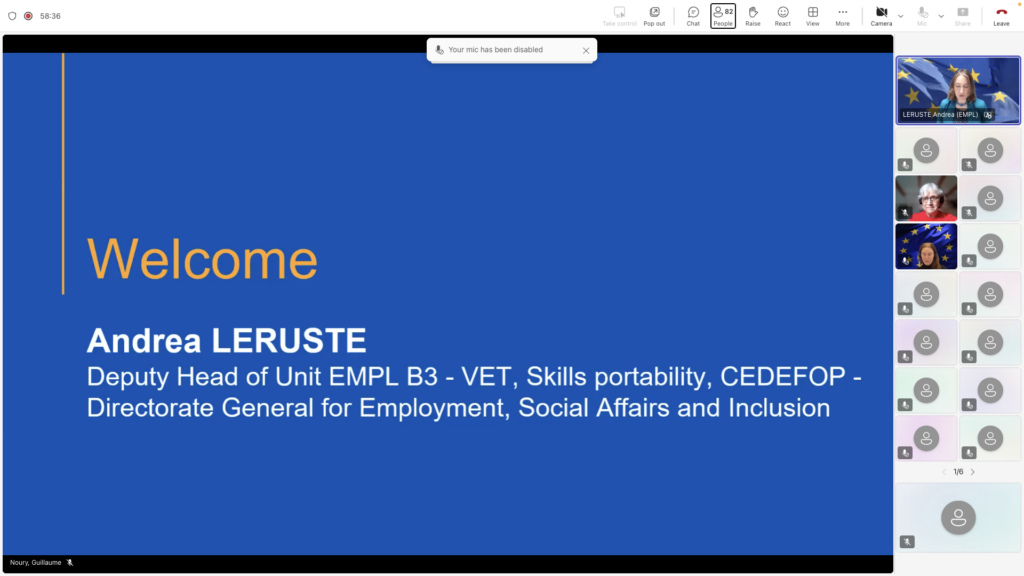
On 23 February 2026, the European Commission hosted the second consultation webinar in the series shaping the future European Strategy for Vocational Education and Training (VET) 2026–2030. Entitled “Future-Proofing VET: Ensuring Quality and Responsiveness to Labour Market Needs”, the online meeting gathered over 115 participants, including social partners, VET providers, practitioners, public authorities and experts from across Europe.
Building on the first consultation dedicated to the international dimension of VET, this second session focused on a core question for Europe’s skills agenda: how to ensure that VET systems deliver high-quality learning while remaining agile and responsive to rapidly evolving labour market demands.
The webinar was opened by Ms Andrea Leruste, Deputy Head of Unit for Vocational Education and Training, Skills Portability at DG Employment, Social Affairs and Inclusion, who underlined the strategic importance of maintaining strong quality standards while enabling VET systems to adapt to the green and digital transitions. She emphasised that stakeholder input is essential to grounding the future EU VET Strategy in practical realities across Member States.
Discussions were structured around three key policy dimensions.
Strengthening basic skills within VET
Participants reflected on the growing challenge of uneven basic skills preparedness among VET entrants. Evidence presented during the session, including monitoring work from Cedefop, points to declining levels of literacy, numeracy and digital skills in several countries. This raises important policy questions about how VET programmes can reinforce foundational competences without diluting occupational specificity.
Participants exchanged views on balancing curriculum time, assessment approaches and financing responsibilities, while ensuring that learners are equipped for lifelong learning and adaptability in changing labour markets.
Empowering teachers and trainers as drivers of quality
A second focus area addressed the central role of VET teachers and trainers in ensuring both quality and innovation. Contributions highlighted common challenges across Europe, including ageing workforces, shortages in certain sectors, and fragmented professional development systems.
The discussion stressed the need for coherent frameworks for initial training, induction and continuous professional development, as well as stronger partnerships between VET providers and employers. Participants also pointed to the importance of making VET teaching careers more attractive and future-oriented, particularly in light of digitalisation and the increasing use of new technologies.
Enhancing responsiveness and system agility
The third strand of debate examined how VET systems can better anticipate and respond to emerging skills needs. Effective feedback loops between labour market intelligence, qualification design and curriculum updates were identified as key enablers of agility.
Examples from Member States, Centres of Vocational Excellence and employer associations illustrated approaches such as curriculum flexibility at regional level and strengthened work-based learning arrangements, including intercompany training centres that support SMEs in delivering high-quality apprenticeships. Participants emphasised that governance structures, employer engagement and robust quality assurance mechanisms are critical to combining flexibility with consistency.
Following working group discussions, participants reported back in plenary and reflected on how these insights should inform the future EU VET Strategy. Exchanges focused on the added value of European cooperation in supporting teachers and trainers, addressing basic skills gaps within VET systems, and strengthening mechanisms for anticipating and responding to labour market change.
As with the first webinar, this meeting forms part of a structured consultation process feeding into a synthesis report and subsequent policy discussions. The contributions gathered will help shape the evidence base and policy orientations of the forthcoming Communication on the future EU VET Strategy, expected later this year.
The strong engagement and diversity of perspectives confirmed a shared commitment across the VET community to ensuring that Europe’s systems remain both high-quality and future-proof.