

Strengthening Regional Skills Partnerships: New Opportunities for Cooperation under the Pact for Skills and EAfA
24/11/2026
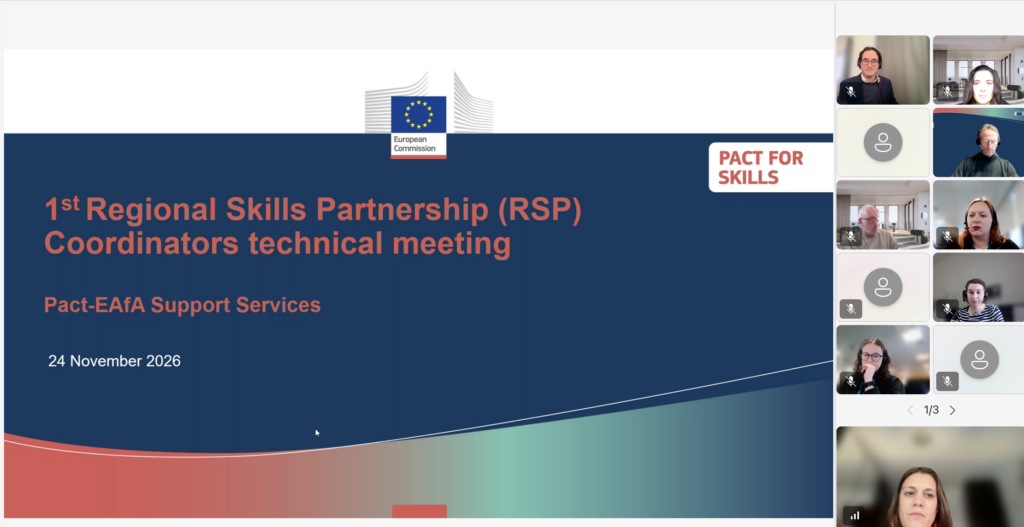
On 24 November 2026, the first meeting of Regional Skills Partnerships (RSP) Coordinators under the renewed Pact for Skills and European Alliance for Apprenticeships (EAfA) Support Services brought together partnership coordinators and European stakeholders to discuss future priorities, support opportunities and ways to strengthen cooperation across regions.
The meeting marked an important milestone in the implementation of the new Support Services contract, which brings together support for the Pact for Skills and the European Alliance for Apprenticeships. This joint approach aims to create stronger synergies between the two initiatives, encourage collaboration among their members and strengthen the contribution of regional partnerships to Europe’s skills objectives.
Bringing European skills priorities closer to the regions
The Pact for Skills continues to play a central role in the European skills agenda, bringing together stakeholders from different sectors to address skills shortages and support upskilling and reskilling. Its ecosystem currently includes 20 Large-Scale Skills Partnerships (LSPs) and 48 Regional Skills Partnerships, alongside the European Alliance for Apprenticeships.
Regional Skills Partnerships have a particularly important role in translating European priorities into concrete action on the ground. By bringing together regional and local authorities, employers, education and training providers, social partners and other relevant organisations, they help ensure that skills strategies respond to the specific economic, labour-market and social needs of each territory.
As highlighted by Manuela Geleng from the European Commission’s Directorate-General for Employment, Social Affairs and Inclusion (DG EMPL), regional partnerships are essential to ensuring that the objectives of the Pact for Skills are implemented at local and regional levels. They connect European ambitions with the organisations responsible for delivering training, supporting workers and responding to changing skills needs.
This role is becoming increasingly important in the context of the Union of Skills and the European Commission’s recent policy developments on education and skills, including the European Education and Skills Package and the renewed focus on vocational education and training.
A renewed approach to supporting regional partnerships
One of the main developments presented during the meeting was the introduction of a common support framework for the Pact for Skills and EAfA. The new Support Services will provide a range of activities designed to consolidate existing partnerships, strengthen their capacity and facilitate cooperation.
The new framework also introduces regular meetings for RSP coordinators, expected to take place quarterly, including two in-person meetings. Knowledge exchange events, Cooperation Fora and a new online synergies tool will further support collaboration.
A joint Pact for Skills and EAfA pledge form will also make it easier for interested organisations to participate in both initiatives.
Connecting regional and large-scale partnerships
Strengthening cooperation between Regional Skills Partnerships and Large-Scale Skills Partnerships was one of the central themes of the meeting.
A new simplified approach to Regional Pledges was presented, allowing interested Large-Scale Skills Partnerships to develop a single regional pledge that can include commitments from multiple regions. This approach aims to facilitate cooperation between European sectoral partnerships and regional stakeholders, helping to connect sector-specific skills needs with the realities of local labour markets.
Improving skills intelligence and responding to labour-market needs
Another important area of work under the renewed Support Services concerns skills intelligence.
Understanding current and emerging skills needs is essential for ensuring that training provision responds to labour-market developments. To support this, the initiative will include an annual skills briefing presenting trends and workforce needs across EU countries over the previous 12 months.
Further activities will aim to strengthen links with the future EU Skills Intelligence Observatory, including mapping existing data, facilitating exchanges between coordinators and projects, and exploring how regional knowledge can contribute to a broader European understanding of skills needs.
EARLALL’s contribution: connecting regional cooperation with lifelong learning and mobility
EARLALL is actively contributing to this agenda through its Regional Skills Partnership for Lifelong Learning Mobility, launched on 17 September 2024.
The partnership aims to increase vocational education and training (VET) mobility opportunities across Europe and promote a stronger culture of lifelong learning. Particular attention is given to improving access to educational and professional opportunities for people with fewer opportunities.
This work is further developed through the ROAM project – Regional Opportunities for Adult Mobility and Skills Development. ROAM aims to strengthen the role of regional and local authorities in promoting adult learning mobility and using mobility as a tool to improve adults’ skills, support upskilling and reskilling, and respond to labour-market needs.
Bringing together four European regions and two municipalities from Italy, Germany, Spain, Sweden and Norway, alongside the Lifelong Learning Platform (LLLP), the project works to improve cooperation between regional actors and connect regional skills strategies with European priorities.
The Regional Skills Partnership provides an important framework for this cooperation, bringing together public authorities, education and training providers, employers and other stakeholders. Through the project, partners will develop regional and local roadmaps, organise training seminars, study visits and webinars, and create practical tools to support adult learning mobility.
The ambition is not only to strengthen cooperation during the project but also to ensure that the partnership continues to develop and expand beyond its lifetime.
Looking ahead: stronger partnerships and more coordinated action
The first RSP Coordinators Meeting under the new Support Services contract opened a discussion on how regional partnerships can be better supported and how cooperation across the Pact for Skills ecosystem can be strengthened.
The outcomes of the discussions will help shape the support provided in the coming months, taking into account the different priorities and needs of regional partnerships.
For EARLALL and its members, this renewed framework offers opportunities to further connect regional skills initiatives, promote lifelong learning and mobility, and strengthen the role of local and regional authorities in implementing European skills priorities.