

Smart Specialisation Takes Centre Stage at 2026 S3 CoP Annual Conference
24/06/2026
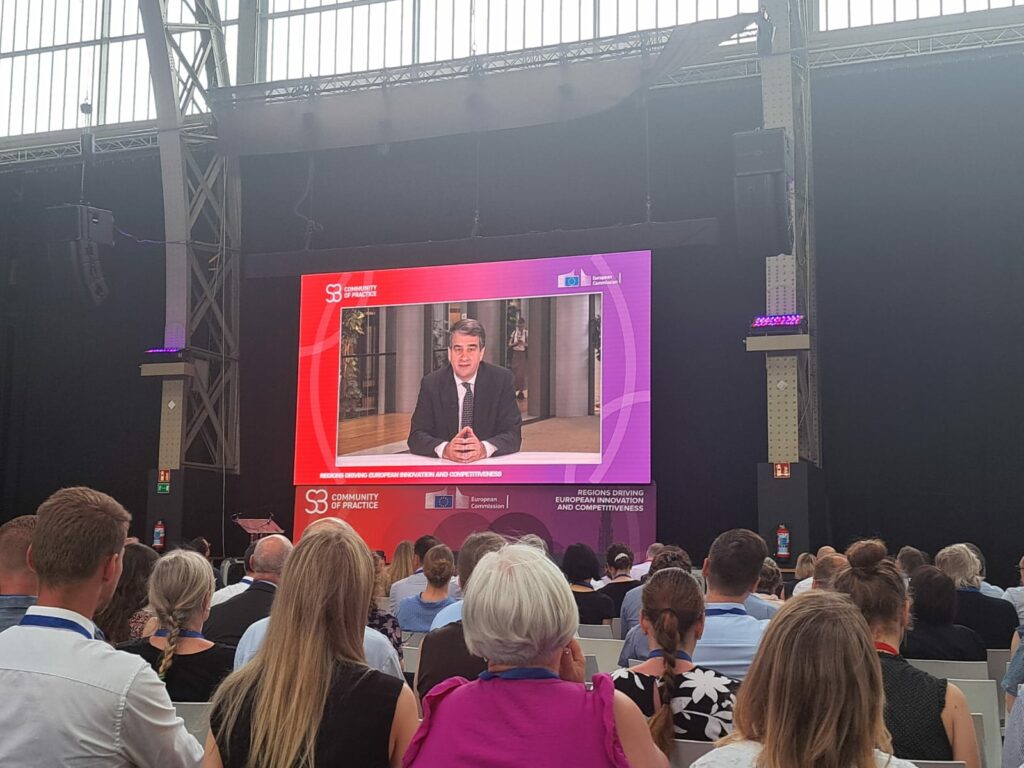
On 23 June 2026, the European Commission’s Directorate-General for Regional and Urban Policy convened the S3 Community of Practice Annual Conference, “Regions Driving European Innovation and Competitiveness,” bringing together regional authorities, national ministries, and EU institutions to discuss the future of Smart Specialisation Strategies (S3). EARLALL’s Director, Noelia Cantero, attended on behalf of the Association.
The day opened with remarks from Nicola de Michelis (DG REGIO) and a keynote video message from Raffaele Fitto, Executive Vice-President for Cohesion and Reforms, who framed Smart Specialisation as a cornerstone of Europe’s competitiveness, sovereignty, and cohesion agenda. A keynote from Verkor’s Donia Marzougui illustrated this in practice, tracing how Hauts-de-France became a European battery manufacturing hub through targeted industrial transition strategies.
Two morning panels reinforced the conference’s central message: S3 are indispensable tools for regions navigating an increasingly complex policy landscape. The first panel, featuring voices from the European Commission, the Committee of the Regions, and regional development agencies, examined how Smart Specialisation supports strategic sovereignty alongside competitiveness. The second turned to delivery, exploring how regions operationalise S3 across governance structures, policy mixes, and interregional cooperation, with contributions from Galicia, Sweden’s Jönköping County, and Poland’s Małopolska Region.
The afternoon’s regional pitches showcased Smart Specialisation in action across diverse territories, from La Réunion to North Denmark and the Northern Netherlands, before participants split into breakout sessions covering multi-level governance, performance-based delivery, and interregional value chains. Notably, Amaia Esquisabel of the Basque Government’s Ministry of Science, Universities and Innovation contributed to the breakout session on delivery and performance – a useful touchpoint given EARLALL’s own ties to the Basque Country.
Throughout the day, speakers repeatedly highlighted a shared message: as the EU prepares for the 2028–34 programming period, Smart Specialisation Strategies remain a key instrument for aligning regional innovation priorities with Europe’s wider goals on cohesion, competitiveness, and sovereignty. While S3 is not part of EARLALL’s core mandate, it continues to offer useful inspiration for how regions identify and organise their skills and training needs. EARLALL was therefore pleased to see Smart Specialisation strongly reaffirmed by EU institutions at this conference, especially following its limited visibility in the European Commission’s initial Multiannual Financial Framework (MFF) proposal. In this context, EARLALL also participates in the SKYLA project (Smart Specialisation Skills Ecosystems for the Twin Transition), which brings together eight regions—Tuscany, Podlaskie, Skåne, Sofia, Fingal, Provence-Alpes-Côte d’Azur, and Lithuania—to help address skills gaps linked to the green and digital transitions by strengthening the role of vocational education and training in regional innovation ecosystems, improving links between SMEs and VET providers, and enhancing regional capacity to anticipate and respond to evolving skills needs.
EARLALL will continue to follow these developments closely in the months ahead.