

Skills and Jobs: How SMEs Go Digital – Insights from Cedefop and Eurofound
05/12/2025
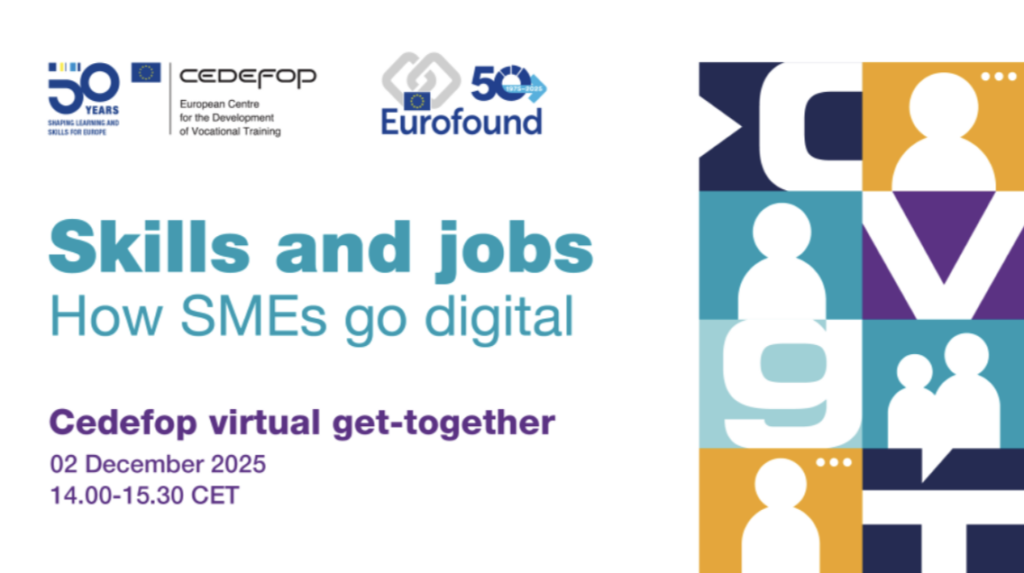
On 2 December 2025, EARLALL took part in the virtual event “Skills and Jobs: How SMEs Go Digital”, jointly hosted by Cedefop and Eurofound. The webinar brought together European stakeholders, experts, and SMEs representatives to explore new data, trends, and policy insights on the digital transition of small and medium-sized enterprises (SMEs) across Europe.
Opening the event, Juergen Siebel, Executive Director at Cedefop, emphasised that “leadership is foresight,” underlining the importance of EU flagship initiatives that strengthen skills development in times of ongoing polycrises. Siebel also highlighted the vital cooperation between Cedefop and Eurofound, before giving the floor to Ivailo Kalfin, Executive Director at Eurofound. Kalfin reiterated that SMEs remain “the backbone of the European economy”, yet often face significant constraints in today’s fast-evolving economic and political context. He stressed the importance of human capital, upskilling and accessible support structures for SMEs.
Data-driven insights into SMEs digital capacity
Presenting Eurofound’s latest findings, Research Manager Franz Eiffe noted that only a minority of EU Member States have reached the benchmark for SMEs digital readiness. Successful digitalisation, he explained, depends heavily on digital literacy and coherent policy and legislative frameworks. Building on this, Jasper Van Loo, Department Coordinator at Cedefop, outlined the main barriers SMEs encounter, pointing to the high costs of Information and Communication Technology (ICT) professionals, uneven progress in digital skills between geographical areas and limited access to tailored training programmes as persistent challenges. Further highlighting opportunities such as digital maturity programmes and mentoring schemes, stressing the need to anticipate future skills demands, he reminded participants that “renewing your skills becomes increasingly important,” especially with emerging gaps in AI understanding and usage.
Panel discussion: Perspectives from SMEs and skills experts
A dynamic panel discussion followed, Valentina Guerra, Policy Director at SMEUnited, noted that the COVID-19 pandemic was a major turning point for SMEs digitalisation. She highlighted the importance of ensuring that upcoming EU digital policies, such as the Digital Omnibus, are designed with SMEs in mind. Thomas Oberholzner, Director at KMU Forschung, built upon Guerra´s message, stating that SMEs often struggle to build internal digital expertise by further emphasising the importance of stronger networks to access knowledge.
Representing the BCS Digital Skills Academy in Estonia, Ants Sild highlighted three key messages. First, digital businesses must not be overlooked in broader economic development. Second, companies require clear pathways connecting education providers, training structures and public funding. Finally, traditional enterprises need targeted outreach and tailored support to start their digital transition.
Dr. Mairéad Nic Giolla Mhichíl, coordinator of the DigiAdvance project, presented an EU-funded approach designed to help SMEs adopt digital innovation more effectively. The initiative offered 40 training courses tailored to SME employees and managers and networking events connecting SMEs with digital innovation experts. Dr. Nic Giolla Mhichíl emphasised that when digital strategy becomes essential for business survival, it becomes a powerful catalyst for skills development. She noted that SMEs value concise, practical learning and often benefit from targeted modules even without completing full courses.
The event highlighted the growing importance of digital skills, targeted support measures and strong collaboration across European institutions and regional authorities. By taking part in this exchange, EARLALL continues to promote policies and cooperation that advance lifelong learning and digital skills development – key enablers for resilient regions and the sustainable growth of SMEs across Europe.