

PATHWAYS officially launches: Strengthening education and training pathways for people in prison across Europe
09/10/2026
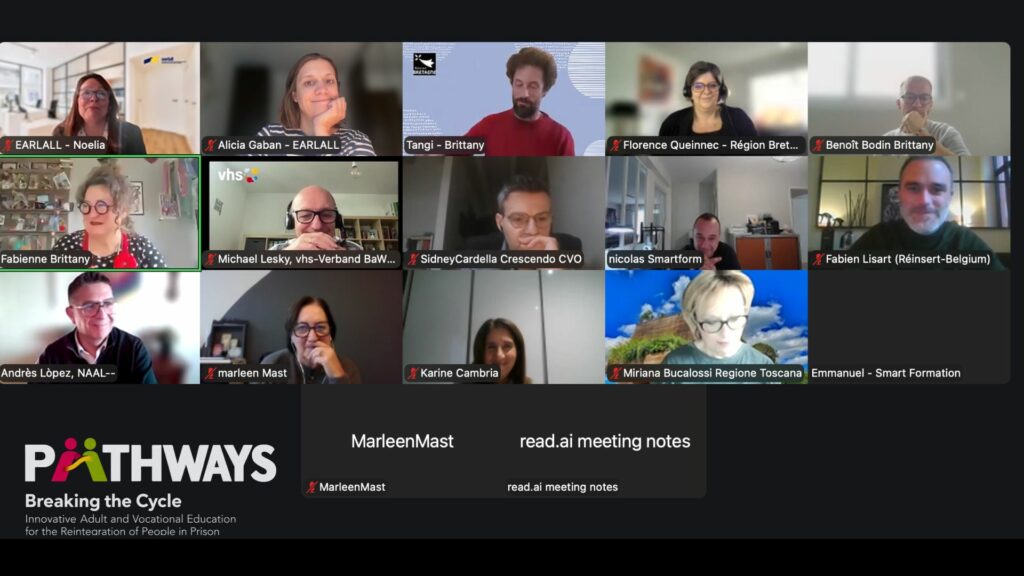
9 October 2026 – The European Erasmus+ project PATHWAYS – Breaking the Cycle: Innovative Adult and Vocational Education for the Reintegration of People in Prison was officially launched during its first online partner meeting on 9 October 2026, bringing together organisations and regional stakeholders from across Europe to strengthen adult education for people in prison and those under criminal justice supervision.
The project aims to improve access to inclusive, flexible and high-quality learning opportunities by identifying effective practices, strengthening cooperation between education providers and prison authorities, and supporting the development of sustainable education and training pathways. By fostering knowledge exchange and professional development, PATHWAYS seeks to contribute to better educational continuity, improved employment prospects and successful reintegration into society.
Building stronger prison education systems through European cooperation
Prison education systems across Europe face a range of challenges, including fragmented provision, unequal access to learning opportunities and difficulties ensuring continuity of education. PATHWAYS addresses these challenges by bringing together partners from different European regions to share experiences, identify promising approaches and explore how successful practices can be adapted to different institutional and regional contexts.
Over its 36-month implementation period, the project will bring together research, peer learning, capacity building and practical implementation through five work packages:
- Project management and coordination
- Mapping prison education ecosystems: gathering information on existing systems, identifying needs and documenting effective practices across participating regions.
- Peer learning and capacity building: supporting the exchange of experiences and strengthening the competences of prison educators and other relevant stakeholders.
- Regional implementation plans and practical tools: translating project findings into actionable resources and approaches that can be applied in diverse prison education settings.
- Communication and knowledge transfer: sharing project results, fostering a European Community of Practice and promoting the long-term uptake of successful approaches.
From mapping needs to practical solutions
The project’s first meeting marked the beginning of this collaborative process. Partners introduced their organisations and roles, reviewed the project structure and discussed the coordination, communication and research activities that will guide the initial phase of implementation.
A key priority is the mapping of prison education systems and the collection of comparable information across participating regions. Through a dedicated data collection tool and local stakeholder workshops, partners will examine existing provision, identify challenges and gather insights to inform the development of practical solutions.
Supporting educators and creating lasting impact
At the heart of PATHWAYS is the recognition that education plays a vital role in personal development, social inclusion and successful reintegration. Equipping educators with practical tools, strengthening links between education providers and prison authorities, and improving access to relevant learning opportunities can help create more coherent and effective pathways for people in prison.
Expected results include a comparative European analysis of prison education, an online repository of effective practices, a practical toolkit for prison educators, regional implementation plans and policy recommendations. The project will also foster a European Community of Practice, enabling professionals and institutions to continue exchanging knowledge and experience.
By combining evidence-based approaches with regional cooperation and practical implementation, PATHWAYS aims to support prison education systems that are more inclusive, adaptable and sustainable.
Looking ahead
Following the launch meeting, partners will begin the initial mapping and data collection activities, refine the project’s communication and dissemination arrangements, and coordinate the next stages of implementation. Dedicated working meetings and local stakeholder workshops will help ensure that the project responds to the needs and realities of the participating regions.
Through this shared European effort, PATHWAYS seeks to turn knowledge and collaboration into meaningful improvements in prison education, helping ensure that learning opportunities remain accessible and that educational pathways can support people both during imprisonment and after release.
About PATHWAYS
PATHWAYS is a European Erasmus+ cooperation project focused on strengthening adult education for people in prison and those under criminal justice supervision. Through research, the exchange of effective practices, professional development, practical tools and regional cooperation, the project aims to improve the quality and continuity of prison education and support sustainable pathways towards education, employment and social reintegration.