

Funding Mobility, Driving Competitiveness: Why Europe Must Continue Investing in Learning Mobility
01/07/2026
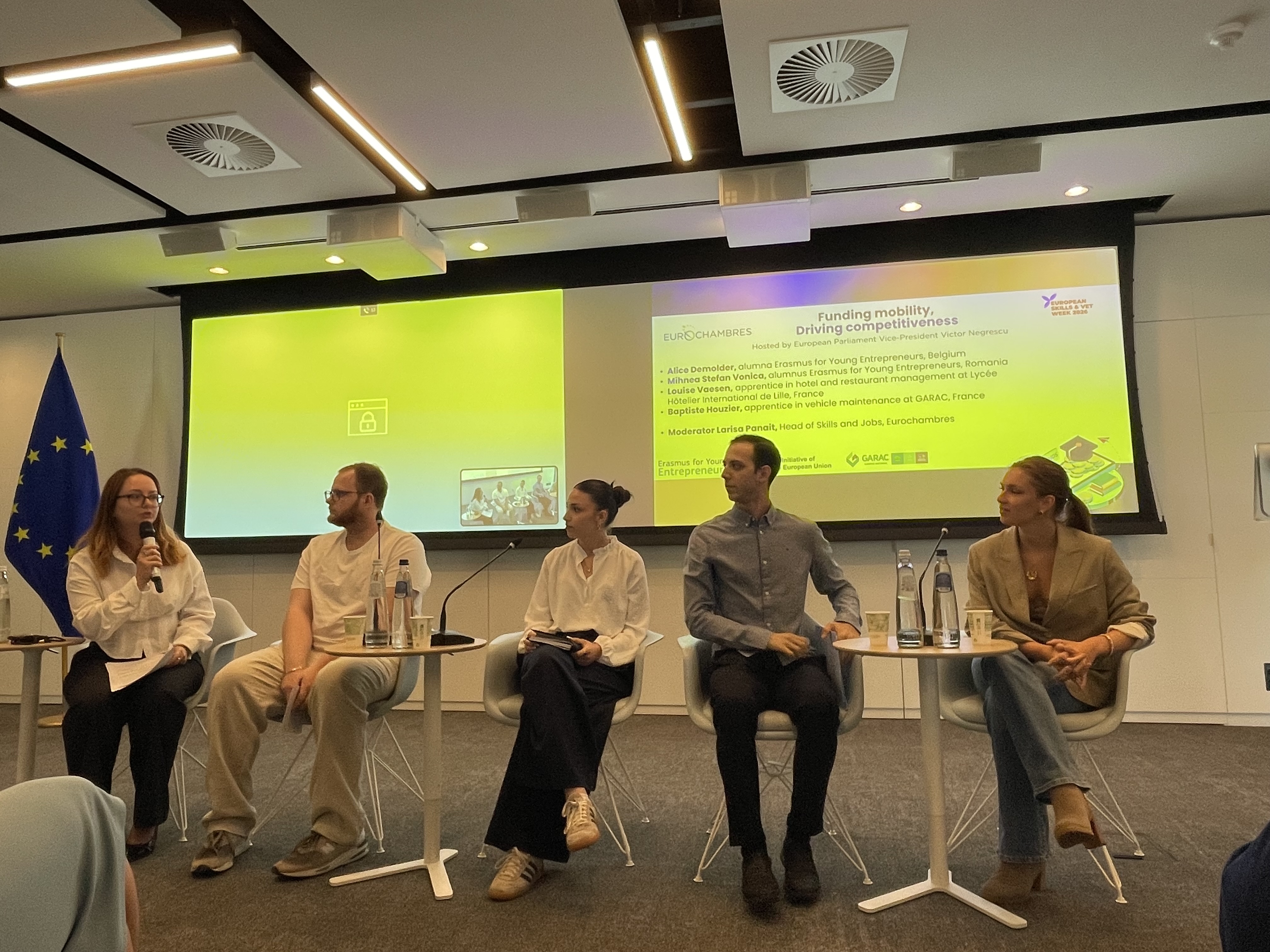
The EARLALL Secretariat attended the high-level event “Funding Mobility, Driving Competitiveness”, organised by EUROCHAMBRES and hosted by Vice-President of the European Parliament Victor Negrescu, which brought together European policymakers, practitioners, apprentices, entrepreneurs and business representatives to discuss the future of mobility programmes in the context of the upcoming negotiations on the European Union’s Multiannual Financial Framework (MFF).
The event delivered a clear and compelling message: investing in mobility means investing in people, and investing in people is investing in Europe’s competitiveness.
Opening the discussion, Ben Butters, Eurochambres CEO, highlighted the significant challenges Europe currently faces, including demographic change and persistent skills shortages, particularly among SMEs. According to Eurochambres’ membership surveys, finding workers with the right skills remains one of the greatest challenges for European businesses. In this context, learning mobility is not only an educational policy instrument but also a strategic tool for competitiveness that equips individuals with technical, entrepreneurial, personal, and intercultural skills that are increasingly essential in today’s labour market.
Representatives of the European Commission provided an overview of current and future priorities related to mobility and skills. Mariella Masselink, Head of Unit at DG GROW, presented the achievements of the Erasmus for Young Entrepreneurs programme, which has successfully facilitated more than 15,000 cross-border exchanges. She emphasised that entrepreneurial mobility generates value for both new and host entrepreneurs by fostering international networks, business creation, innovation and intercultural understanding. Notably, around 80% of participants report gaining a stronger understanding of entrepreneurship, while over one-third go on to establish successful businesses.
Looking ahead to the next EU budgetary cycle, Masselink stressed that support for SMEs, women and young entrepreneurs must remain a priority. She also underlined the European Commission’s commitment to simplifying funding instruments, allowing entrepreneurs to focus on building their businesses rather than navigating administrative complexity.
The importance of learning mobility within vocational education and training (VET) was highlighted by Jan Varchola from DG Employment, Social Affairs and Inclusion. He recalled the European target that, by 2030, at least 12% of VET learners should benefit from mobility experiences abroad. However, current participation rates remain at around 5%, primarily due to funding limitations and structural barriers.
While demand for mobility opportunities continues to grow, available funding remains insufficient. In 2024, only 56% of Erasmus+ mobility applications in the VET sector could be approved, leaving a significant share of demand unmet. Additional obstacles include administrative burdens for SMEs, challenges in recognising learning outcomes acquired abroad, and difficulties in establishing reliable mobility partnerships.
The discussion also offered important insights into the forthcoming European VET Strategy, expected to be adopted by the European Commission in October 2026. The strategy aims to address emerging skills needs, strengthen the attractiveness of VET pathways and ensure that vocational education remains fit for a rapidly changing labour market. In parallel, ongoing work on skills portability seeks to remove barriers to labour mobility by improving the recognition and validation of qualifications and competences across Europe and beyond.
One of the most inspiring moments of the event was the dialogue with former participants of mobility programmes. Entrepreneurs and apprentices shared personal experiences that demonstrated the transformative impact of mobility opportunities. They highlighted not only the acquisition of practical and professional skills but also increased self-confidence, adaptability, intercultural awareness and entrepreneurial mindsets.
Their testimonies reinforced a powerful message: mobility experiences change lives. They encourage individuals to step outside their comfort zones, develop resilience and acquire skills that directly contribute to Europe’s economic and social development.
In his concluding remarks, Ben Butters summarised four key priorities for the future of European mobility policies:
- Europe must continue investing in mobility as a strategic investment in both individuals and businesses.
- Vocational education and training learners and apprentices must remain at the centre of mobility programmes and continue to benefit from strong support through Erasmus+.
- Mobility opportunities must become more accessible, particularly for SMEs, through simplification and reduced administrative burdens.
- Skills recognition and portability must be strengthened to facilitate labour mobility and help businesses access the talent they need.
For EARLALL, these discussions strongly resonate with our commitment to promoting quality vocational education and training, lifelong learning and regional cooperation across Europe. As discussions on the next Multiannual Financial Framework intensify, the event served as an important reminder that mobility programmes are not a cost, but a strategic investment in Europe’s future competitiveness, resilience and social cohesion.