

From Vision to Action: Building Skills for Europe’s Digital Future
16/04/2026
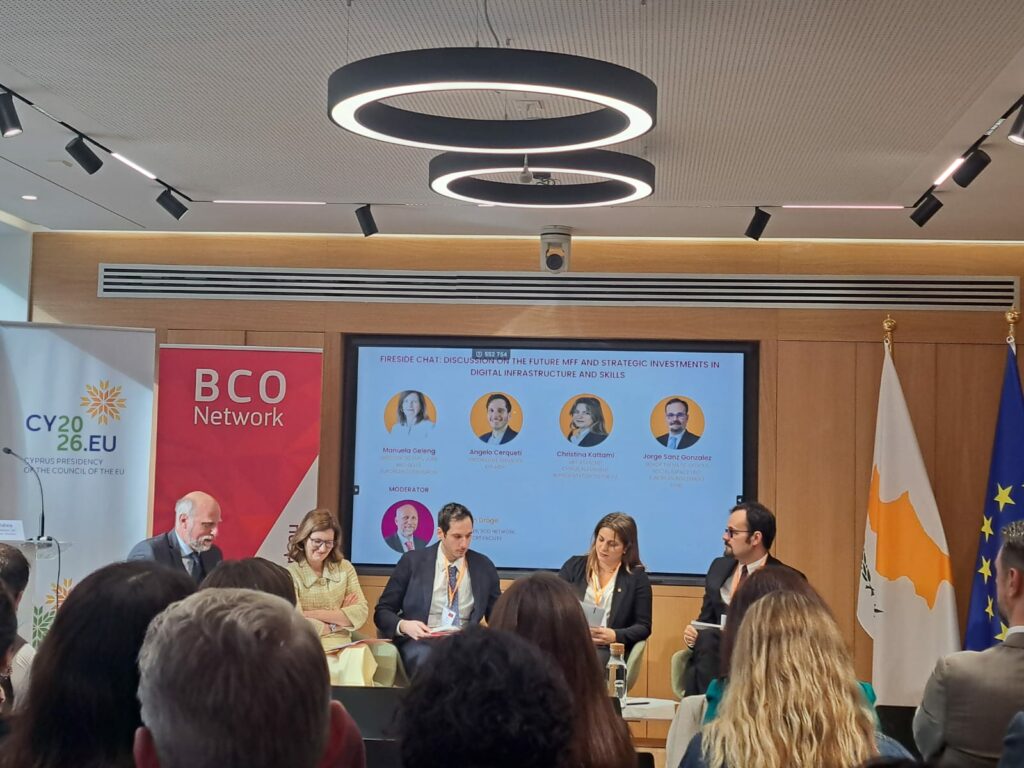
On 16 April 2026, stakeholders from across Europe gathered in Brussels for the event “From Vision to Action: Empowering Skills Development, Capacity Building and Inclusive Learning in Europe.” Hosted at the Representation of Cyprus to the EU, the event brought together policymakers, industry leaders, regional actors, and education stakeholders to address one of the most urgent challenges facing Europe today: ensuring an inclusive digital transition that leaves no one behind.
Opening the event, Giorgos Ioannides, Deputy Permanent Representative, Cyprus Permanent Representation to the EU, emphasised a fundamental principle: digital transformation must be built on universal connectivity. Without equal access across urban, rural, and remote areas, technological progress risks widening existing inequalities rather than reducing them.
Yet infrastructure alone is not enough. Speakers stressed that digital skills are the true engine of transformation. Europe’s digital future, they argued, must be a collective project—one in which citizens, businesses, and institutions evolve together.
In the first panel, Manuela Geleng,Director DG EMPL, Jobs and Skills, European Commission, highlighted the dual role of skills in shaping Europe’s future. On one hand, they are essential for economic competitiveness; on the other, they are critical for social cohesion.
The figures illustrate the urgency:
- 9 out of 10 jobs already require digital skills
- Only 60% of Europeans possess at least basic digital skills
- The EU aims to reach 80% by 2030
This gap becomes even more pressing as AI continues to reshape labour markets. Skills policy is therefore not just about employment—it is central to Europe’s broader economic and social strategy, as reflected in initiatives like the Draghi Report on European Competitiveness.
Discussions made clear that Europe has already laid substantial groundwork. Initiatives such as the Pact for Skills have helped train millions through industry-led alliances. New efforts are also emerging, including Skills Academies, strengthened vocational education and training (VET), and a Human Capital recommendation published earlier this year.
Looking ahead, the European Commission is piloting a “skills guarantee” for sectors undergoing transition—an initiative expected to become part of the future Competitiveness Fund under the next Multiannual Financial Framework (MFF).
A key takeaway from the event was the need to rethink how learning systems operate. Traditional education pathways are no longer sufficient in a rapidly evolving digital economy.
Participants highlighted the importance of:
- Lifelong learning, with continuous upskilling and reskilling
- Stronger inclusion of VET learners alongside higher education
- Addressing practical barriers, such as housing for trainees and apprentices
Skills policy is now deeply embedded across EU funding instruments, from the Social Fund to Erasmus+, reinforcing its central role in Europe’s development.
Christina Kattami,MFF Attache’, Cyprus Permanent Representation to the EU, offered a broader geopolitical perspective, aligning the discussion with the Cyprus Presidency’s vision of “an autonomous Europe open to the world.”
She emphasized that digital policy is no longer confined to a single sector—it now acts as a horizontal enabler across the entire economy. From national programmes to external EU actions under Global Europe, digital priorities are integrated at every level.
However, translating these ambitions into concrete budget allocations within the MFF remains a complex political process.
The second panel focused on artificial intelligence and its growing impact on the workplace. Findings from Adecco revealed a cautiously optimistic outlook:
- 67% of workers believe AI is creating more jobs
- Roles are becoming more complex and hybrid
- Both technical and ethical skills are increasingly important
At the same time, a mismatch persists. While 60% of employers expect workers to upskill, many organizations lack structured AI strategies. This highlights a critical point: responsibility for skills development must be shared between individuals, employers, and institutions.
The event underscored that Europe is not lacking in vision, strategy, or funding. The real challenge now lies in implementation—at scale and at speed.
As emphasized by participants, achieving a truly inclusive digital transition will require:
- Closing the digital skills gap
- Ensuring equal access across all regions
- Aligning education systems with labour market needs
- Building flexible, lifelong learning ecosystems
Ultimately, the message was clear: Europe’s digital future can only succeed if it is shared—across sectors, regions, and people.