

Excellence, Innovation and Entrepreneurship in VET: Third Consultation Webinar Advances the Future EU Strategy
02/03/2026
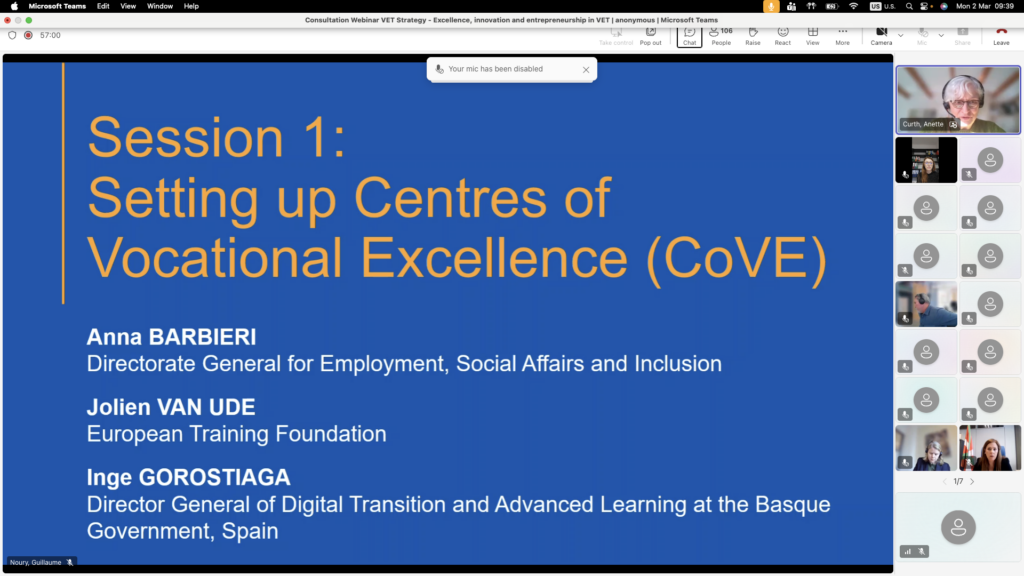
On 2 March 2026, the European Commission hosted the third consultation webinar in the series shaping the future European Strategy for Vocational Education and Training (VET) 2026–2030. Entitled “Excellence, innovation and entrepreneurship in VET”, the online session brought together policymakers, VET providers, social partners, regional authorities and experts from across Europe to reflect on how to scale up vocational excellence and strengthen VET’s contribution to competitiveness and innovation.
Following the previous sessions on the international dimension and on quality and labour market relevance, this third webinar focused on four interconnected priorities: Centres of Vocational Excellence (CoVEs), VET-business partnerships, innovative pedagogies, and entrepreneurship education.
The meeting was opened by Ms Andrea Leruste, Deputy Head of Unit at DG Employment, Social Affairs and Inclusion, who reiterated the importance of grounding the future EU VET Strategy in practical experience from Member States and regions. She emphasised that excellence in VET must be inclusive, embedded in regional ecosystems, and aligned with Europe’s digital and green transitions.
Centres of Vocational Excellence as engines of systemic change
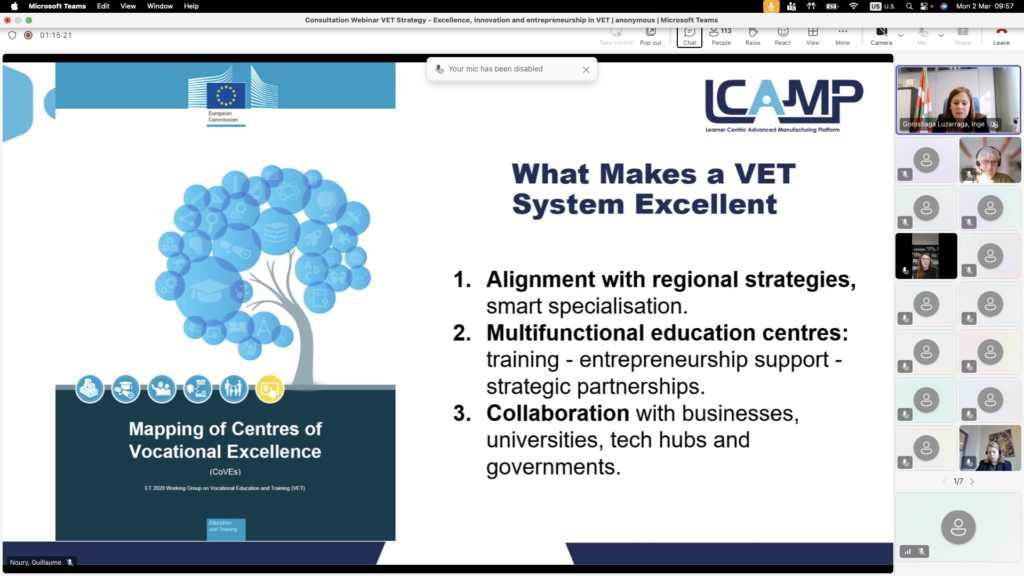
The first session explored the role of Centres of Vocational Excellence (CoVEs) as drivers of innovation and regional development. Anna Barbieri (DG EMPL) presented insights from the recent analysis of Erasmus+ CoVE projects, highlighting how vocational excellence is achieved through strong skills ecosystems, partnerships across the “knowledge triangle” (education, business and research), and learner-centred approaches supported by quality assurance.
A particularly strong contribution came from Inge Gorostiaga, Director for Digitalisation and Advanced Learning at the Basque Government and Vice-President of EARLALL.
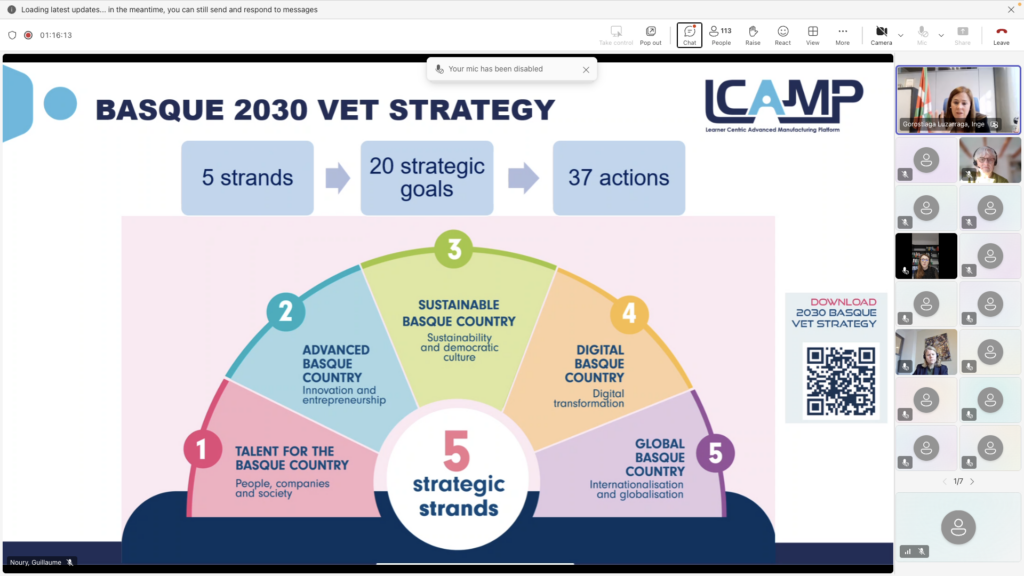
In her intervention, she presented the vision underpinning the VI Basque VET Strategy 2030, which positions VET at the heart of regional competitiveness, industrial transformation and social cohesion. She underlined how long-term political commitment, strong governance, and close cooperation with companies have enabled the Basque Country to embed vocational excellence within a comprehensive innovation ecosystem.
She also showcased the LCAMP (Learner Centric Advanced Manufacturing Platform), a European flagship Centre of Vocational Excellence project focused on advanced manufacturing. LCAMP promotes transnational collaboration, innovative learning environments and joint curriculum development aligned with industrial needs.
Inviting participants to engage further, she encouraged regions and organisations to join the LCAMP Alliance and to take part in the upcoming LCAMP Conference in Vitoria-Gasteiz in April 2026, as a space for peer learning, networking and scaling up vocational excellence across Europe.
Her intervention illustrated how regional leadership, European cooperation and structured ecosystems can move excellence from project level to system-wide transformation.
Strengthening VET-business partnerships
The second session focused on developing structured and sustainable VET-business partnerships. Panellists and participants examined both formal governance arrangements—particularly in dual systems—and more flexible, needs-driven cooperation models.
Discussions highlighted the importance of joint training facilities, shared equipment and innovation hubs, especially to support SMEs in accessing new technologies. Participants also reflected on the announced VET Business Partnerships initiative under the European Competitiveness Fund, noting its potential to facilitate technology transfer, applied research and upskilling in critical sectors.
Across interventions, a common message emerged: employer engagement must go beyond consultation and become a genuine co-design process, embedded in curricula development, delivery and assessment.
Innovative pedagogies and entrepreneurial mindsets
The third thematic strand addressed innovative teaching and learning approaches and the promotion of entrepreneurship in VET. Contributions showcased learner-centred methodologies such as project-based learning, challenge-driven formats and the use of emerging technologies including AI, VR and digital twins.
Participants also reflected on the integration of entrepreneurship competences, building on the EntreComp framework developed by the European Commission. Discussions emphasised that entrepreneurship is not limited to business creation but includes broader competences such as initiative, creativity, resilience and ethical thinking—skills essential across all sectors.
Micro-credentials, modular pathways and flexible qualification designs were identified as important tools to enhance both innovation and lifelong learning opportunities, although challenges remain regarding recognition and integration into national qualification frameworks.
Feeding into the future EU VET Strategy
The final plenary session invited participants to reflect on how excellence, innovation and entrepreneurship can be embedded at system level. Discussions pointed to the need for:
- Clear definitions and shared reference frameworks for vocational excellence;
- Long-term governance arrangements and quality assurance mechanisms;
- Stronger European peer learning and mutual support;
- Continued investment in teacher and trainer professional development;
- Better alignment between VET, regional innovation ecosystems and industrial policy.
As with the previous webinars, insights collected during the discussions and via interactive exchanges will feed into a synthesis report and inform the forthcoming Communication on the future EU VET Strategy.
The strong engagement from European, national and regional stakeholders—including the active contribution of the Basque Government —demonstrated a shared commitment to ensuring that VET systems are not only responsive to labour market needs, but also engines of excellence, innovation and entrepreneurial capacity across Europe.