

EARLALL contributes to the new EAfA Toolkit on Strengthening Basic Skills through Apprenticeships
19/11/2026
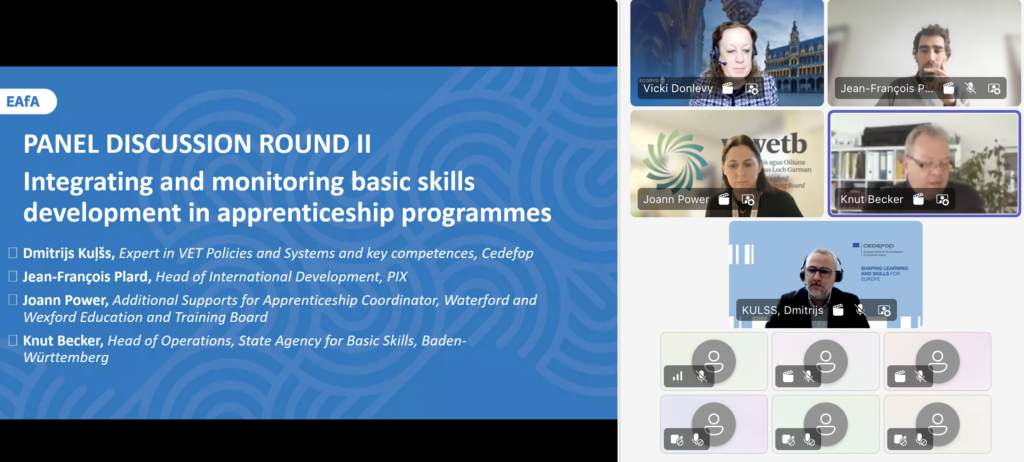
On 19 November 2026, the European Alliance for Apprenticeships (EAfA) organised the webinar “Integrating Basic Skills in Apprenticeship Programmes – Introducing the New EAfA Toolkit”, bringing together European experts and practitioners to discuss the importance of basic skills in apprenticeships and work-based learning (WBL).
The event had two main objectives: to present the EAfA Toolkit on Strengthening Basic Skills through Apprenticeships and to discuss the challenges, opportunities and practical steps for integrating basic skills development into apprenticeship programmes and work-based learning.
Basic skills, encompassing literacy, numeracy, science, digital and citizenship competences, are essential foundations for employability, lifelong learning and active participation in society. They enable individuals to enter and navigate the labour market, adapt to technological and economic changes, and continue developing their competences throughout their careers. However, many learners enter vocational education and training (VET) and apprenticeship programmes with gaps in these foundational skills, making it important to identify their needs and provide appropriate support.
Strengthening basic skills: the European policy context
The webinar opened with a presentation by Andrea Leruste from the European Commission’s Directorate-General for Employment, Social Affairs and Inclusion (DG EMPL), who provided an overview of current European initiatives and policy developments related to basic skills.
The discussion highlighted the importance of basic skills within the EU’s broader skills agenda, including the Union of Skills and the Council Recommendation on reversing the decline in basic skills (2026), introduced on 5 November 2026 as part of the European Commission’s Education and Skills Package. Strengthening these competences is not only an educational priority but also a matter of employment, social cohesion and competitiveness.
In the context of vocational education and training, apprenticeships should provide more than occupation-specific competences. They should also help learners develop the foundational skills needed to understand workplace procedures, adapt to new technologies, exercise their rights and responsibilities, and continue learning throughout their professional lives.
Identifying and assessing basic skills needs
The first panel discussion focused on understanding and assessing basic skills needs, bringing together representatives from Cedefop, PIX, Waterford and Wexford Education and Training Board in Ireland, and the State Agency for Basic Skills Baden-Württemberg in Germany.
Participants discussed the importance of identifying skills gaps at an early stage and ensuring that employers and VET providers work together to address them.
Dmitrijs Kulss from Cedefop highlighted the need to connect basic skills development more closely with occupational learning and workplace experiences. Employers and training providers have complementary roles in ensuring that apprentices can develop these competences in practical settings. He also stressed the potential of work-based learning to support citizenship education, while recognising the need for stronger cooperation between companies and VET institutions.
Jean-François Plard, Head of International Development at PIX, focused on digital skills and the importance of assessment. He challenged the assumption that young people are automatically digitally competent because they use smartphones and applications in their everyday lives. Digital skills are much broader, and apprentices may have significant gaps that need to be identified and addressed. PIX’s approach combines assessment, self-assessment and certification, helping both learners and organisations understand existing competences and identify learning needs.
Representing Waterford and Wexford Education and Training Board, Joann Power shared the Irish experience of supporting apprentices from the beginning of their training. Early identification of potential difficulties allows providers to offer appropriate support and adapt learning pathways to individual needs.
Knut Becker, Head of Operations at the State Agency for Basic Skills Baden-Württemberg and representing EARLALL, highlighted the importance of cooperation, particularly when working with small and medium-sized enterprises. Smaller companies often have limited capacity to address apprentices’ basic skills needs independently. Intermediary organisations, including Chambers of Commerce, can therefore play an important role in connecting employers with the necessary expertise and support.
Integrating basic skills into apprenticeship programmes
The second panel discussion moved from identifying needs to exploring how basic skills can be integrated into apprenticeship programmes and how learners’ progress can be monitored.
A key message was that basic skills should be connected to real occupational tasks and practical workplace situations rather than treated as separate or isolated subjects. Contextualised teaching approaches can make learning more meaningful and help apprentices understand the relevance of literacy, numeracy, digital and other competences in their professional activities.
The speakers also underlined the importance of preparing teachers and in-company trainers to recognise and address different learning needs. This requires appropriate methodologies, dedicated time and resources, as well as effective cooperation between education and training providers and employers.
The discussion further highlighted the importance of monitoring apprentices’ progress throughout their learning journey. Regular assessment, documentation of skills development and feedback from learners and trainers can help adapt learning plans and improve the quality of support.
Citizenship competences were also recognised as an important dimension of apprenticeship education. As discussed by Cedefop, democratic values and participation cannot be developed through theoretical learning alone; apprentices should also have opportunities to experience and practise them in their everyday environments, including at the workplace.
Introducing the EAfA Toolkit on Strengthening Basic Skills through Apprenticeships
A central part of the webinar was the presentation of the new EAfA Toolkit on Strengthening Basic Skills through Apprenticeships, developed to support employers, VET providers and other stakeholders in integrating basic skills development into apprenticeship programmes.
The toolkit provides key concepts, an overview of relevant European policies and funding instruments, step-by-step guidance, practical examples and a checklist to support implementation.
Its guidance covers three main areas:
- Understanding and assessing basic skills needs: mapping skills to workplace tasks, building partnerships, conducting initial basic skills assessments and identifying available funding resources.
- Integrating basic skills into apprenticeship programmes: incorporating basic skills into programmes and individual learning plans, preparing teachers and in-company trainers, and adapting learning environments and teaching methods.
- Supporting learners’ progression: following apprentices’ basic skills development, recording progress and gathering feedback to improve learning.
The toolkit aims to help stakeholders move from identifying basic skills gaps to implementing concrete support measures throughout the apprenticeship journey.
EARLALL contributes regional expertise and good practices
EARLALL contributed to the final revision of the EAfA Toolkit, providing feedback and regional perspectives through its assessment of the draft toolkit on basic skills. This contribution also involved EARLALL working group leaders Miriana Bucalossi (Tuscany Region), Camilla Winter (Västra Götaland) and Andrea Bernet-Bürkle (Volkshochschulen Baden-Württemberg), who shared their expertise and input during the revision process.
The toolkit also features two good practices introduced by EARLALL experts, showcasing regional approaches to basic skills development:
- Democracy Reading Club (Baden-Württemberg, Germany): Developed by the Basic Skills Centre (Grundbildungszentrum) Schwäbisch Gmünd in cooperation with the local library, the initiative combines literacy, citizenship education and media literacy through practical activities. It helps adults strengthen their basic skills and confidence through community participation, while preparing them for further learning, including vocational pathways.
- Individual Training Plans for Wine Technicians (Tuscany, Italy): Presented in Bucalossi et al. (2024), Bridging Tradition and Innovation: Dual Apprenticeships for Wine Technicians in Siena, this example highlights individualised training approaches in apprenticeship programmes, connecting professional learning with the needs of learners and the sector.
Through these contributions, EARLALL brings its members’ regional experience and practical knowledge into the European toolkit, demonstrating the value of regional cooperation and the exchange of practices in strengthening basic skills.