

EARLALL contributes to EU evaluation of Individual Learning Accounts (ILAs)
18/11/2026
EARLALL has contributed to a study supporting the European Commission’s evaluation of the 2022 Council Recommendation on Individual Learning Accounts (ILAs). A workshop on 16 November 2026 brought stakeholders together to discuss the study’s emerging findings and where more evidence is needed.
Adopted on 16 June 2022, the Recommendation aims to help more working-age adults take part in training and reduce skills gaps. It invites Member States to consider introducing ILAs, which give adults a personal entitlement to funding for eligible training. The European Commission, through its Directorate-General for Employment, Social Affairs and Inclusion (DG EMPL), commissioned a consortium led by Fondazione Giacomo Brodolini to carry out the supporting study. The evaluation examines progress across Member States and assesses the Recommendation’s effectiveness, efficiency, coherence, relevance and EU added value. The Commission is due to report to the Council by 17 June 2027.
What did the study find?
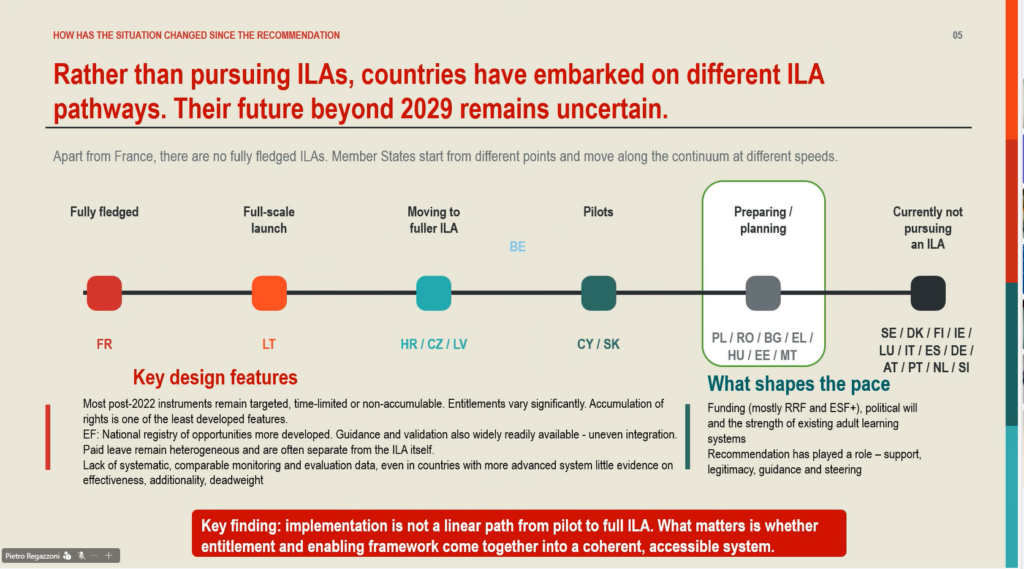
The preliminary findings presented at the workshop show that Member States are developing individual learning accounts (ILAs) at different speeds and in different ways. France is the only country identified as having a fully developed system, while Lithuania has reached the full-scale launch stage. Croatia, Czechia and Latvia are moving towards more comprehensive schemes, and Cyprus and Slovakia are piloting their approaches. Several other countries are preparing or planning schemes. Sweden is among the countries that the study identified as currently not pursuing an ILA. However, it offers a comparable measure in addition to regular adult education that provides financial support to eligible adults who undertake studies to strengthen their position in the labour market
Most measures introduced since the 2022 Council Recommendation are targeted at specific groups, limited in time or designed so that adults cannot build up training entitlements over time. Many countries have national registers of training opportunities and offer guidance and validation of prior learning, but how closely these services are linked to the accounts varies. Paid training leave is often managed separately.
The study team pointed to funding, political commitment and the strength of existing adult learning systems as factors shaping the pace of implementation. The Recommendation has helped give national initiatives direction and legitimacy, while their future beyond 2029 remains uncertain. Comparable evaluation data are still limited, making it difficult to tell whether the schemes enable adults to take up training they would otherwise have missed.
What helps adults take up training?
The workshop highlighted the role of adult education providers in reaching people who rarely take part in training. In Croatia, for example, vouchers for basic digital skills were well received. The workshop discussion highlighted that learners needed considerable help to identify which skills they wanted to develop, choose a course and apply for funding.
Time and income were also central to the discussion. Adults may need to reduce their working hours to study or fit training around family responsibilities. Paid training leave is available in some of the countries covered by the study, and employers can help by giving staff time to learn.
Participants discussed how ILAs can bring information on training, funding and career guidance together in one place. They also stressed the importance of regional labour market conditions. Adults may find it harder to justify investing time in training when there are few local jobs where they can use their new skills or when employers offer little recognition for higher skills.
What difference do the accounts make?
The workshop raised a question for the evaluation that participation figures alone cannot answer. Are the accounts helping adults take up training they would otherwise have missed? This is especially important for adults who have had fewer opportunities to learn. As the evaluation enters its final stages, the discussion also highlighted the need to understand how the accounts can work alongside existing adult education and employment services and how they can be financed over time.