

EARLALL at the EU Lifelong Learning Stakeholders’ Forum 2025
09/12/2025
The EU Lifelong Learning Stakeholders’ Forum on the future EU Budget (MFF), organised by the Lifelong Learning Platform (LLLP), took place on 8 December in Brussels as part of Lifelong Learning Week 2025. The event marked the 20th anniversary of the LLLP and brought together regional authorities, civil society organisations, practitioners and academia to discuss the future of EU education and skills policies, with a particular focus on the next Multiannual Financial Framework (MFF). EARLALL participated to ensure that regional perspectives and territorial needs were clearly represented in the debate.
A Forum to Shape the Future of EU Lifelong Learning Policies
In her opening remarks, Raffaela Kihrer, Secretary General of the Lifelong Learning Platform (LLLP), stressed the importance of nurturing learning “from cradle to grave” and highlighted key milestones that have shaped the EU’s lifelong learning agenda. She underlined that the upcoming MFF represents a critical moment for stakeholders to influence long-term investment in education, skills and sustainability.
Participants then heard from Michael Teutsch, Acting Director for Youth, Education and Erasmus+ at DG EAC. Teutsch explained the current state of negotiations around the next Erasmus+ programme, noting that although budgetary pressure has led to reductions across several EU programmes, the value of youth and education for Europe’s social and economic fabric remains strong. He further emphasised the need to reinforce inclusion across all educational sectors and encouraged stakeholders to “make your voices heard with the European Parliament”, particularly regarding both the strengths and shortcomings of the initial proposal. Teutsch also highlighted the importance of ensuring that programmes remain accessible for people with fewer opportunities and stated that the Commission is open to discussing implementation details within the broader legislative framework.
Bringing Territorial Perspectives to the Centre: EARLALL’s Intervention
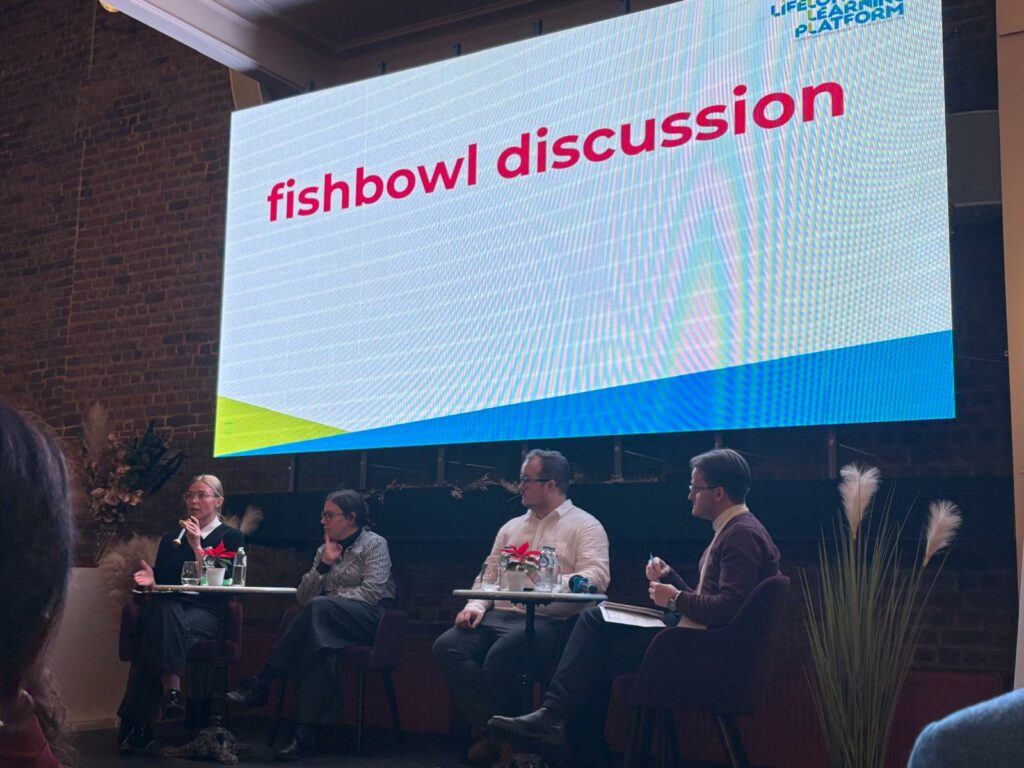
Andrei Frank, Policy and Advocacy Manager at LLLP, then opened a fishbowl discussion, offering stakeholders an opportunity to share their reflections on the upcoming MFF. Olga from the EARLALL Secretariat joined the stage to underline a key message: the next MFF must fully recognise regional and local authorities as strategic partners in EU education and skills policies.
Olga highlighted the importance of ensuring systematic territorial involvement throughout the design, implementation and monitoring of Erasmus+. The network called for stronger investment in capacity-building, accessibility and administrative simplification, particularly to support smaller regions. It also emphasised the need to preserve a balanced and holistic vision of learning, recognising transversal competences, active citizenship and personal development as essential alongside competitiveness. In terms of funding, EARLALL stressed the importance of predictable multi-year allocations for key sectors such as VET, adult learning and youth. Finally, it highlighted that flagship initiatives — including Centres of Vocational Excellence, European Universities and Teacher Academies — must be firmly rooted in regional ecosystems, complemented by continued support for small-scale and newcomer partnerships.
Collective Reflections in the World Café
The forum concluded with a World Café session, where participants exchanged perspectives on the challenges and opportunities ahead. Discussions highlighted:
- Misalignment between national interpretations of inclusion and EU-level intentions;
- A need for clearer, more detailed information to assess and engage with the proposed MFF;
- Opportunities to think beyond the limits of the current programme and explore long-term, KPI-driven solutions;
- The importance of flexibility in future funding structures;
- Growing interest in external funding mechanisms, though not yet reflected in policy processes.
Despite concerns, the atmosphere remained constructive, with many participants noting that there is still hope for a stronger and more ambitious MFF. EARLALL continues to advocate for regional voices within this dialogue, reaffirming the essential role of territories in driving social inclusion, innovation and skills development across Europe.