
Basque Education Minister and EARLALL Vice President Begoña Pedrosa shares the Basque experience at the UNESCO and European Commission policy dialogue on education beyond 2030
13/11/2026
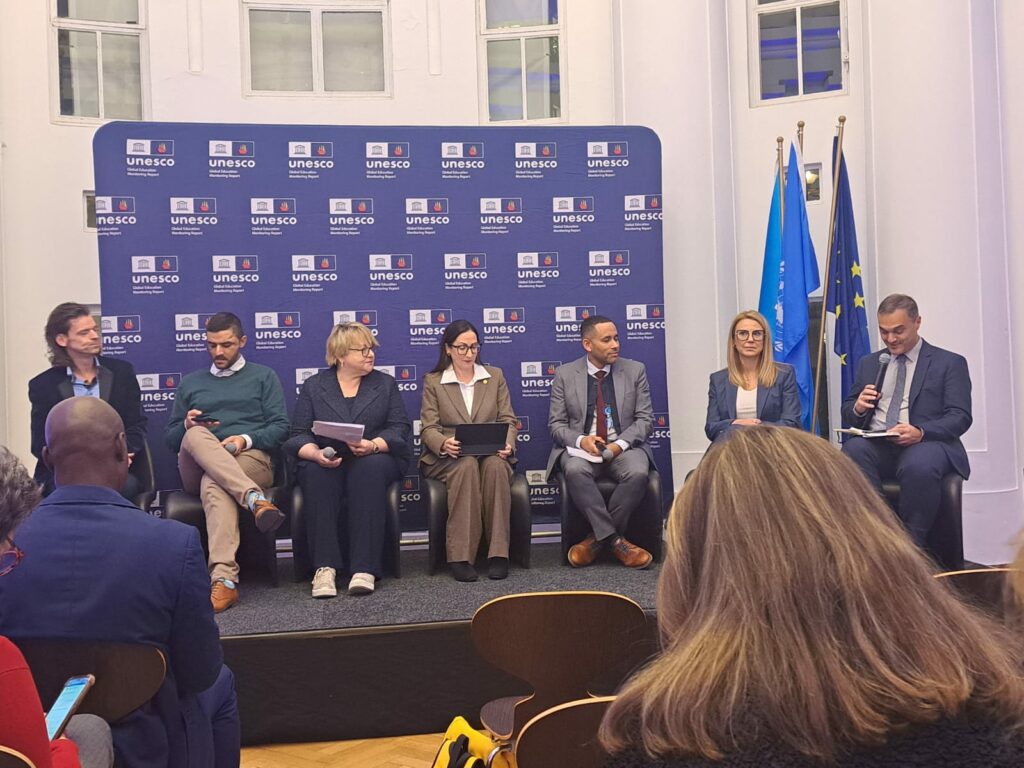
Begoña Pedrosa, Minister of Education of the Basque Country and Vice President of EARLALL, took part in the European Policy Dialogue “Countdown to 2030”, held at BOZAR in Brussels. The event was organised by the UNESCO Liaison Office to the EU and the European Commission’s Directorate-General for International Partnerships (DG INTPA), to mark the European presentation of the 2026 Global Education Monitoring (GEM) Report.
The dialogue brought together policymakers and international organisations to look at the post-2030 education agenda and at what 25 years of progress on access and equity can tell us about the road ahead. Lodovico Folin Calabi, Director of the UNESCO Liaison Office in Brussels and UNESCO Representative to the European Union, acted as master of ceremonies. Manos Antoninis, Director of the GEM Report, presented the report and moderated both discussions.
Part 1: Education beyond 2030, a global perspective
The first session, moderated by Manos Antoninis, looked at how evidence from the GEM Report can inform cooperation with partner countries. It featured Martin Seychell, Deputy Director-General of DG INTPA at the European Commission; H.E. Prof. Torerayi Moyo, Minister of Primary and Secondary Education of Zimbabwe; André Deloh, Director of Programme Monitoring and Oversight at the Ministry of National Education of Côte d’Ivoire; David Edwards, General Secretary of Education International; and Moira V. Faul, Executive Director of NORRAG.
Several messages stood out:
- Funding: Aid to education has fallen, with a sharp drop in aid to basic education. Foundational learning in Africa remains a central concern.
- Education as a journey: The aim is not only to get children into school but to equip them with competencies that connect with the labour market. This means focusing on VET and on disadvantaged groups, with teachers playing a central role.
- Dropouts and equity: School dropout is often tackled too late, as a last resort, so early warning systems matter. Equity is harder to achieve in contexts of poverty, and measurement tools need to be adjusted to capture it better.
- Zimbabwe: Minister Moyo presented five priority pillars and described education as the only way to achieve the country’s vision. He presented it as a powerful tool for critical thinking and problem-solving skills, and highlighted innovation and industrial hubs and a white paper on foundational literacy and numeracy.
- Education International: The discussion centred on funding and on the central role of teachers.
Part 2: Access and equity in Europe
The second session, also moderated by Manos Antoninis, turned to Europe. National and international education policymakers reflected on what the past 25 years can teach us about advancing equitable access. Speakers were Antoaneta Angelova-Krasteva, Director for Policy Strategy, Country Intelligence and Youth at the European Commission’s DG EAC; Jonas Erin, Senior Policy Advisor at the Council of Europe’s Education Department; Begoña Pedrosa, Minister of Education of the Basque Country; Patrizia Jankovic, Head of EU Educational Cooperation, Multilateral Affairs and EU Legal Affairs at the Austrian Federal Ministry of Education; Maurice De Greef, UNESCO Chair on Adult Education at Vrije Universiteit Brussel; and Panagiotis Chatzimichail, Head of External Affairs at OBESSU.
The Basque Country: inclusion, early support and the role of VET
Minister Pedrosa presented the Basque experience in inclusive education and equal opportunities, in a context of growing diversity among students and of educational and social needs. She stressed personalised attention, educational guidance and early detection of learning difficulties, together with responses adapted to each student’s circumstances throughout their educational path.
She placed particular emphasis on the role of Vocational Education and Training in keeping people learning and easing the transition to employment, especially for those who find it hardest to complete their education. She explained that the Basque VET system offers several pathways. Initial VET includes adapted, integrated and flexible modalities, with personalised guidance and socio-educational support. Dual VET, built on close collaboration with companies, combines learning in schools with training in the workplace. A modular offer also supports lifelong learning, allowing professional competences to be acquired and accredited progressively.
She also noted that effective schools are those where strong leadership and communities that learn together go hand in hand. In her words, education must offer opportunities to everyone regardless of their personal or social situation, and VET has a particularly important role for those who need the most support.
Other contributions
- European Commission: Early childhood education and care is crucial, but disparities persist, especially in rural areas and across socio-economic backgrounds. PISA results show a decline in basic skills, and teacher shortages add to the problem. Investment must go hand in hand with reforms, with VET and lifelong learning (upskilling and reskilling), cooperation with companies and country-specific recommendations as part of the future.
- Council of Europe: The focus was on citizenship and democratic education, diversity as an asset and support for refugees. It also covered digital transformation and AI literacy, with Compass as a practical tool. Technology should serve learners, not replace teachers, and teachers’ professional development should be a priority.
- Austria: The emphasis was on early childhood education, smooth transitions into primary school, professionalisation of childhood educators and support for teaching staff, so that every child has a chance to succeed.
- UNESCO Chair on Adult Education (VUB): Professor De Greef made the case for measuring the impact of adult learning and education (ALE), which is linked to improved knowledge, health and labour-market outcomes. Scaling it up requires more than a top-down approach. It needs professional teachers, tutors and educators rather than volunteers, and a system of referral.
- OBESSU: Meaningful inclusion is not about presence but about power, and it requires accountability. Outreach must go to those who have left school, since they will not come to Brussels. Representativeness and legitimacy are also key.
The session closed with reflections on international and regional priorities from H.E. Mr. El-Hadji Serigne Mbaye Thiam, High Level Envoy and Advisor to the Global Partnership for Education, followed by closing remarks from Lodovico Folin Calabi and a networking reception.
Key messages
- Progress towards 2030 depends on sustained funding, strong teachers and early intervention against dropout.
- VET, adult learning and the inclusion of disadvantaged groups must be part of the post-2030 agenda.
- Equity is about outcomes, so measurement tools need to be better adapted.
EARLALL is proud that its Vice President brought the voice of regional authorities, and the Basque experience in inclusive education and VET, to this European and global discussion.
Further information on the Basque Government’s account of the event is available on Irekia (in Spanish).