

AI and Active Labour Market Policies
11/02/2026
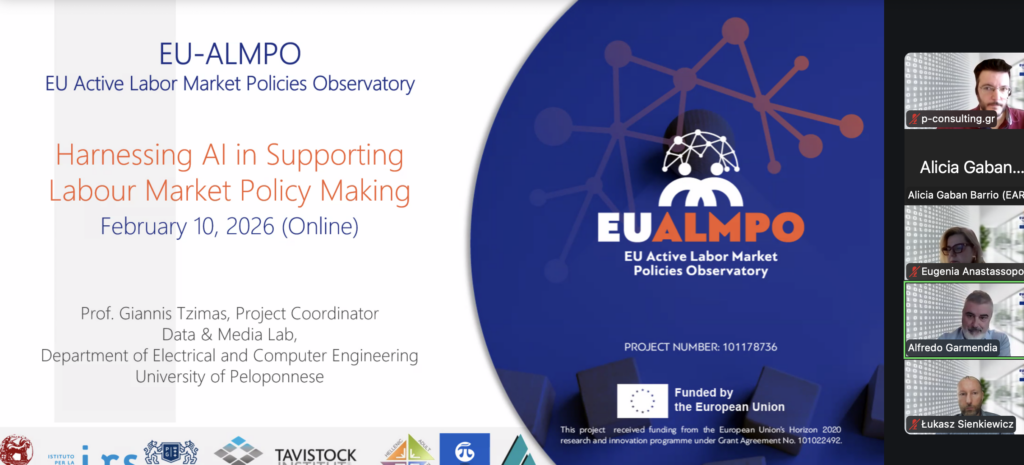
How can Artificial Intelligence strengthen labour market policies at regional level?
This was the central question discussed during the recent EU Active Labour Market Policies Observatory (EU-ALMPO) project Launch Event, Harnessing AI in Supporting Labour Market Policy Making, which brought together representatives from the European Commission, OECD, CEDEFOP, research institutions, and policy practitioners.
For regions, the debate is particularly relevant.
Labour market transitions — driven by digitalisation, green transformation and demographic change — are experienced locally. Regional authorities and Public Employment Services are on the frontline of supporting workers through job transitions, upskilling pathways and inclusive employment strategies.
Key insights from the discussion:
- AI and Generative AI are already reshaping work organisation across sectors — regions must prepare proactively.
- Current evidence does not point to widespread job losses, but rather to task transformation and evolving skill requirements.
- Skills — not technology — are the main bottleneck. Investment in upskilling and reskilling systems is critical.
- Human-centred governance, transparency and trust must underpin the use of AI in labour market policymaking.
- AI can support better targeting, monitoring and evaluation of Active Labour Market Policies — if embedded within strong institutional frameworks.
As a partner in the TRAILS project, EARLALL is actively working on these challenges — supporting regions in anticipating skills needs, strengthening lifelong learning systems, and ensuring that digital and green transitions translate into quality jobs and inclusive growth. The discussions at the EU-ALMPO project event strongly resonate with TRAILS’ objective to bridge research, policy and practice in shaping resilient regional labour markets.
Ensuring that AI-driven tools reflect territorial realities and support regional policy implementation will be key in the months ahead. Cooperation between European initiatives, research institutions and regional stakeholders will determine whether digital transformation enhances both competitiveness and social cohesion.
The transition is underway — and regions have a central role in shaping it.