

Strengthening vocational education and skills policies: European regions exchange experiences with Ukraine
30/10/2026
On 29 October 2026, the Interreg Europe Policy Learning Platform organised the online capacity-building event “Strengthening vocational training to bridge skill gaps”, in cooperation with the Regional Development Agency of Khmelnytskyi Oblast, Ukraine. The event brought together Ukrainian local and regional authorities, education providers, experts and practitioners to discuss how vocational education and training (VET) can respond to changing labour market needs, support lifelong learning and contribute to regional economic development.
Against the backdrop of damaged infrastructure, workforce displacement and persistent skills shortages, strengthening Ukraine’s VET system is an important part of its recovery and reconstruction. Discussions focused on the country’s ongoing VET reform and the role of regional authorities in translating national policy changes into effective training opportunities.
Ukraine’s VET reform: strengthening skills governance and regional cooperation
Iryna Shumik, Director General of the Directorate of Vocational Education and Training, presented the main developments in Ukraine’s new VET framework. Key changes include greater institutional and financial autonomy for VET institutions, stronger employer involvement, more flexible learning pathways, partial qualifications and independent assessment and certification of professional competences.
In 2026, attention shifted towards implementation. New workplace training arrangements were introduced in September, while the updated national VET standard adopted in October requires at least 40% practical training and allows programmes to offer up to three professional qualifications. A new financing model is also under development, linking institutional funding with performance-related elements, regional demand and graduate employment.
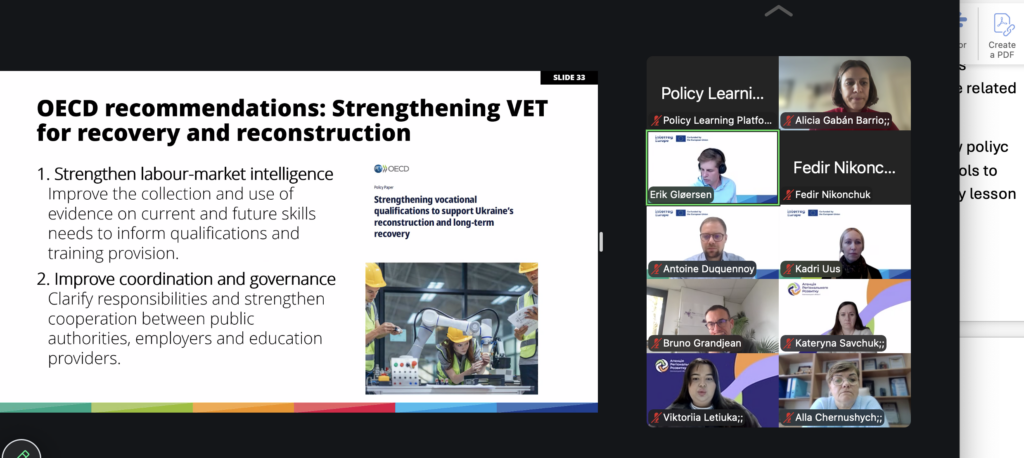
The discussion also drew on OECD recommendations for strengthening VET in Ukraine’s recovery and reconstruction, highlighting the need for better labour market intelligence, stronger coordination between public authorities, employers and education providers, and quality assurance for new learning formats, including micro-credentials.
European regional experiences: connecting skills, education and economic development
The event featured several European practices addressing skills management, digital learning and the integration of vocational training into regional development strategies.
As part of the SKYLA Interreg Europe project, three contributions presented experiences from Sweden, Lithuania and Italy.
- Anders Elmevik, Business Advisor at Region Skåne, Sweden, presented “Mhttps://www.interregeurope.eu/good-practices/mind-the-gap-business-transformation-and-skills-needs-identification-toolind the Gap: Connecting Business Development and Skills Needs”. The approach supports SMEs in identifying immediate recruitment needs while anticipating the competences they will require as their business models evolve. Dialogue with businesses helps connect skills planning with regional economic development.
- Andrius Bečys, Product Owner of Kursuok.lt at the European Social Fund Agency in Lithuania, presented “KURSUOK: A One-Stop Platform for Lifelong Learning”. The national digital platform brings training opportunities and funding information together, allowing learners to compare programmes, apply for funding and obtain certificates. It has registered more than 96,000 users, with over 23,000 people completing training through 320 providers and 3,000 programmes. The experience demonstrates how digital public services can improve access to lifelong learning and connect training provision with national skills priorities.
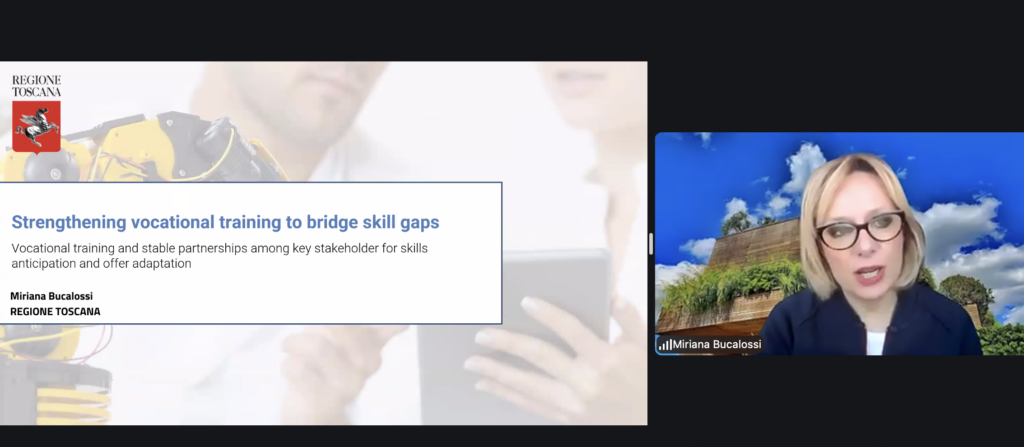
- Miriana Bucalossi, Region of Tuscany, together with Lorenzo Sabatini, from the Agency for the Development of Empolese Valdelsa, presented “Building Regional Skills Ecosystems for the Twin Transition”. Their contribution highlighted the role of ITS Academies, apprenticeships and work-based learning in connecting education with regional smart specialisation strategies. The Tuscan experience showed how cooperation between businesses, education providers, research organisations and public institutions can develop the skills needed in strategic sectors undergoing green and digital transformation.


Skills intelligence, digital learning and lifelong learning
Other contributions broadened the discussion to different dimensions of regional skills policies.
Bruno Grandjean, General Director of Pôle Véhicule du Futur in Grand Est, France, presented an approach to anticipating skills needs through public-private cooperation. From Sweden, Mattias Jaktlund introduced the Distance Campus model in Östersund, combining remote learning with local study facilities, guidance, peer support and connections with employers to improve access to education and employment opportunities.
Stelina Chatzichristou, from Cedefop, explored the role of skills intelligence in the green and digital transitions. Her presentation highlighted the importance of combining forecasting tools and labour market data while recognising their limitations. Quantitative evidence needs to be complemented by local knowledge, stakeholder dialogue and a better understanding of people’s aspirations and changing skills requirements.
The role of regions in building future-ready skills systems
Across the discussions and working groups, a common message emerged: no single institution or policy instrument can address skills gaps alone. Effective skills strategies require cooperation between regional and national authorities, employers, education and training providers, research organisations and social partners.
The exchange also highlighted the importance of connecting VET with wider regional development priorities, including Smart Specialisation Strategies (S3), the green and digital transitions, adult learning and labour market inclusion.
For Ukrainian stakeholders, European regional experiences offered practical inspiration for implementing reforms and adapting training systems to local needs, including those of internally displaced people. The event demonstrated the value of interregional cooperation and policy learning in strengthening regional skills ecosystems and supporting more inclusive, resilient and competitive economies.