

Rethinking care careers: EARLALL brings regional perspectives to gender equality, skills and wellbeing at EURegionsWeek 2026
15/10/2026
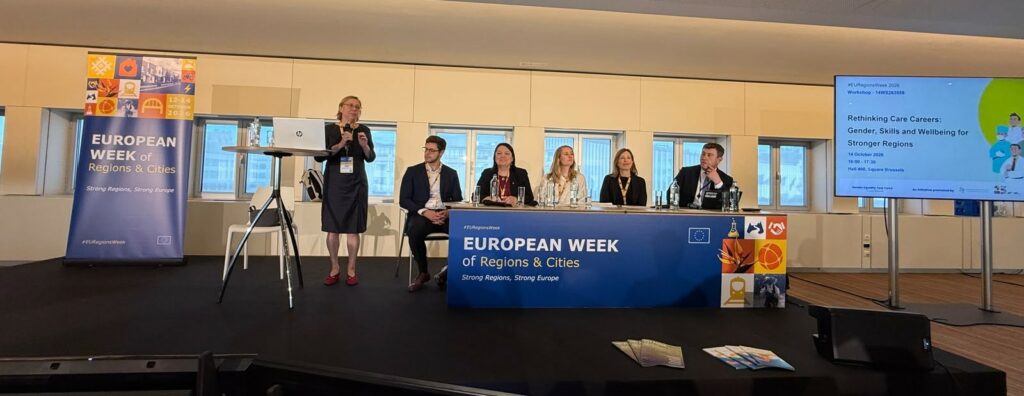
On 14 October 2026, EARLALL co-organised the workshop “Rethinking Care Careers: Gender, Skills and Wellbeing for Stronger Regions” in Brussels as part of the European Week of Regions and Cities. The discussion connected European policy with regional practice, exploring how lifelong learning, fair working conditions and gender equality can strengthen the care workforce.
The workshop was organised by the Gender Equality Task Force for Lifelong Learning, a joint initiative of the European Association for the Education of Adults (EAEA), EARLALL and EfVET. The Task Force monitors developments in the EU Gender Equality Strategy and promotes gender-balanced participation, equal rights and access to lifelong learning.
Opening and moderating the session, Gina Ebner, Head of Policy and Deputy Secretary General at EAEA, invited participants to consider how education and training can address the interconnected challenges of gender inequality, workforce shortages and mental health in care.
For EARLALL, the discussion highlighted the central role of regional and local authorities in connecting skills development with employment, equality and accessible care services. Making care careers attractive requires learning opportunities that lead to fair pay, safe workplaces and meaningful professional progression.
Linking better training with better jobs
Csaba Borboly, Member of the European Committee of the Regions and Vice-President of Harghita County Council, Romania, highlighted the difficulties regions face in attracting young people to care careers. Pay often fails to reflect the responsibilities involved, undermining both the attractiveness of the profession and the sustainability of regional services.
He stressed that employers should provide training and give workers sufficient time to participate. However, training alone cannot resolve poor working conditions. Career guidance and learning opportunities must also be accessible where people live, including in less-developed regions.
Borboly outlined four recommendations:
- Establish permanent regional care skills partnerships involving public authorities, care providers, education institutions and workers.
- Provide targeted support to regions facing acute demographic pressures or staffing shortages.
- Connect training with fair pay, safe working conditions and clear career pathways.
- Measure results beyond participation, including completion rates, job placements, staff retention and wage improvements.
His contribution underlined the need to plan skills and employment policies together, with civil society, employers and care professionals involved in shaping responses that fit their communities.
Making mental health a workplace priority
Violaine Roggeri, Communications Officer at the European Agency for Safety and Health at Work (EU-OSHA), presented the agency’s approach to preventing psychosocial risks. Based in Bilbao, in the Basque Country, EU-OSHA supports safer and healthier workplaces across Europe.
She introduced the 2026–2028 Healthy Workplaces Campaign, “Together for mental health at work”, which promotes awareness and prevention of work-related psychosocial risks.
The figures discussed illustrated the scale of the challenge: 29% of workers reported stress, depression or anxiety caused or worsened by work during the previous 12 months, while more than four in ten reported severe time pressure. These findings are reflected in EU-OSHA’s OSH Pulse 2025 results.
Roggeri also cited estimates placing the cost of mental ill-health at €600 billion annually, equivalent to more than 4% of EU GDP, and indicating that every €1 invested in mental health measures can generate returns of up to €13. Yet stigma remains a barrier: according to the figures presented, fewer than 50% of workers feel comfortable disclosing mental health difficulties.
Psychosocial risks are not gender-neutral. Occupational segregation, unequal unpaid care responsibilities and unfavourable working conditions can contribute to poorer mental wellbeing among women. The discussion also highlighted risks affecting health and social care, education, agriculture, domestic work and construction, alongside workers in lower socioeconomic positions.
The response must address how work is organised. Roggeri advocated manageable workloads, psychosocial risk assessments, worker participation, manager training and organisational change. During the discussion, she clarified that the economic cost of mental ill-health should be understood as evidence of systemic shortcomings, rather than individual weakness.
Centre-Val de Loire: preventing gender-based violence through education
A regional example came from Zoé Dedobbeleer Carlier, CIDFF Eure-et-Loir, the Centre for Information on Women’s and Families’ Rights, who presented an initiative from Centre-Val de Loire (EARLALL member region).
Implemented during 2025–2026, the initiative formed part of a regional strategy adopted in 2023. It responded to findings attributed to France’s National Order of Nurses in 2024, indicating that 49% of nurses had experienced gender-based or sexual violence at work.
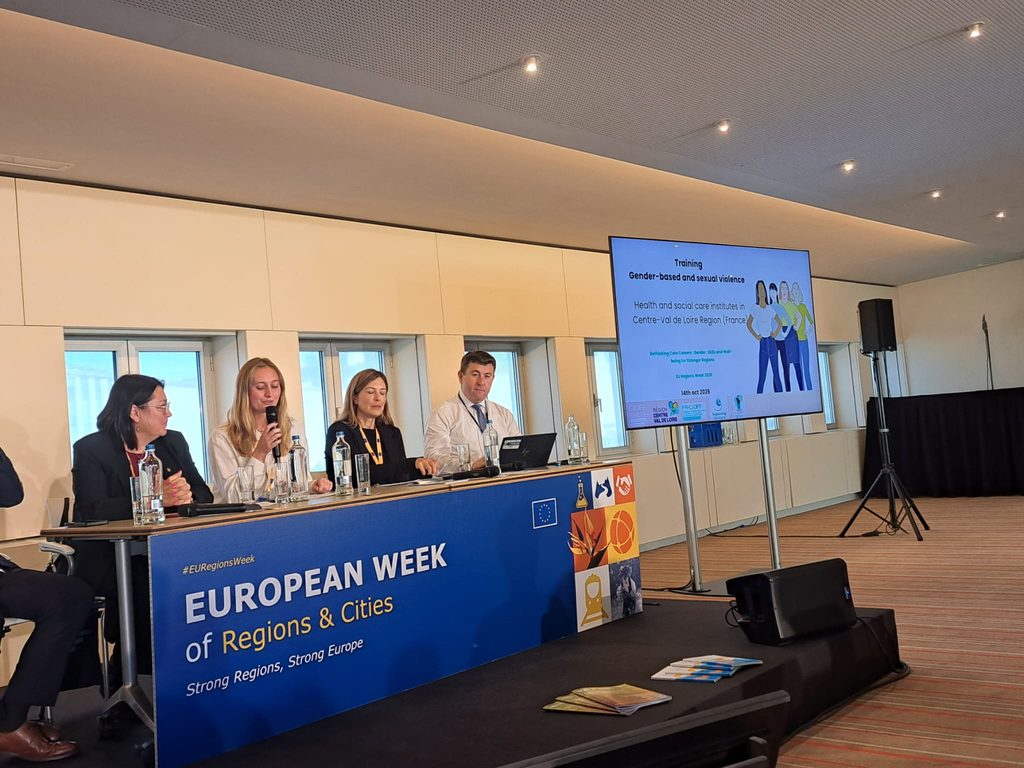
The project brought together two organisations with complementary expertise: Planning Familial, founded in 1956, which works on sexuality education and sexual and reproductive rights, and the CIDFF network, established in 1972, which supports women’s access to rights.
Training targeted both education teams and students. Educators participated in a six-hour training webinar, while students attended three-hour awareness sessions addressing gender stereotypes, consent, coercive control and support for victims.
The initiative reached approximately 1,000 students across 18 institutes, with an average satisfaction score of 4.58 out of 5. Its effects also extended beyond the sessions: one participating institution subsequently organised a full-day forum on the topic.
Dedobbeleer Carlier described resistance encountered during the training, including attempts to minimise violence. This reinforced the importance of addressing its systemic nature and strengthening education in a context of growing masculinist discourse. The region plans to extend the initiative into 2026–2027.
For EARLALL, this example demonstrates how regional strategies can translate gender equality objectives into practical learning experiences for future care professionals and their educators.
South Savo: connecting skills, pay and career progression
Arja Flinkman, CEO and Chief Principal of Etelä-Savon Koulutus Oy / South Savo Education Ltd, presented approaches developed in Finland to improve the attractiveness of health and social care careers amid demographic change.
Her contribution focused on making additional skills visible and rewarding them. A flexible salary model allows practical nurses to increase their earnings through further learning, including partial qualifications and micro-credentials.
Training was designed with employers and teachers around identified skills gaps, enabling staff to develop their competences while remaining in work. Short, targeted learning opportunities and “competence patches” supported modular progression and helped make acquired skills visible.
Flinkman also described changes to the allocation of professional tasks, with practical nurses taking on selected nursing duties and nurses assuming selected tasks previously undertaken by doctors, supported by negotiations involving employers and trade unions.
Workplace learning was central to the approach. During the discussion, she cited a figure of 40% for the workplace-learning component of Finnish VET, highlighting apprenticeship models that combine shorter periods of school-based education with learning on the job. Recognising prior learning and offering partial qualifications can further support people in combining work and study.
The initiatives also produced openly available videos and training materials, allowing organisations beyond the original project to benefit. Family-based care was presented as another entry route, combining contract-based care in a home setting with preparatory training, fair compensation and opportunities for progression.
Her message was that improving recruitment and retention requires cooperation across institutional boundaries. Education providers, employers and policymakers need to listen to one another and connect training decisions with the resources needed to improve care work.
Strengthening VET pathways and challenging stereotypes
Emilio Dogliani, Advocacy and Project Manager at EfVET, explored how vocational education and training can offer stronger career prospects in care.
He called for greater permeability between VET and higher education, enabling learners to move more easily between pathways and continue developing their careers. He also advocated updating the Council Recommendation on VET and including measurable targets for system integration in the forthcoming EU VET strategy.
Dogliani cited a perception gap: three in four EU citizens regard general education as more prestigious than vocational education. He argued that improving VET’s reputation requires investment in quality provision, guidance and visible opportunities for progression.
Gender segregation remains another challenge. While VET overall was described as male-dominated, care-related programmes remain predominantly female. An EU-wide guidance and counselling framework could help challenge stereotypes, encouraging girls to consider STEM and boys to explore care careers.
He also emphasised the importance of transversal competences, including critical thinking, a growth mindset and learning to learn. In care, these must be complemented by empathy, communication and compassion, developed through cooperation between education providers, families and the wider learning community.
Turning discussion into regional action
The interactive discussion brought together the policy and practical dimensions of making care careers more attractive. Participants highlighted fair pay, safe workplaces, flexible working hours, childcare support, clear career pathways and effective anti-harassment policies with confidential reporting procedures.
Encouraging men to enter care professions and share unpaid care responsibilities was identified as part of a broader effort to challenge the devaluation of care as “women’s work”. Gender equality scorecards were suggested as a way for regions to compare progress and exchange practices.
Participants also discussed mentoring, technology and assistive tools as ways to support the workforce. These measures need to accompany improvements in working conditions: career promotion alone cannot compensate for excessive workloads or inadequate pay.
Funding responsibilities extend across governance levels. National governments shape employment rules and finance public services; regional and local authorities coordinate training, partnerships and care provision; and EU funding, including the European Social Fund, can support investment in people. The discussion also raised concerns about the place of social investment in the future Multiannual Financial Framework and the importance of protecting support for the ESF and Erasmus+.
For EARLALL, the workshop reinforced the value of bringing regional experience into European policy discussions. The examples from Centre-Val de Loire and South Savo showed how lifelong learning can support safer workplaces, challenge gender stereotypes and create clearer routes into and through care careers. Regional and local authorities have a crucial role in connecting these efforts so that skills development improves both workers’ prospects and the care available in their communities.