

Quality Apprenticeships in the EU: Key insights from CEDEFOP and European stakeholders
01/07/2026
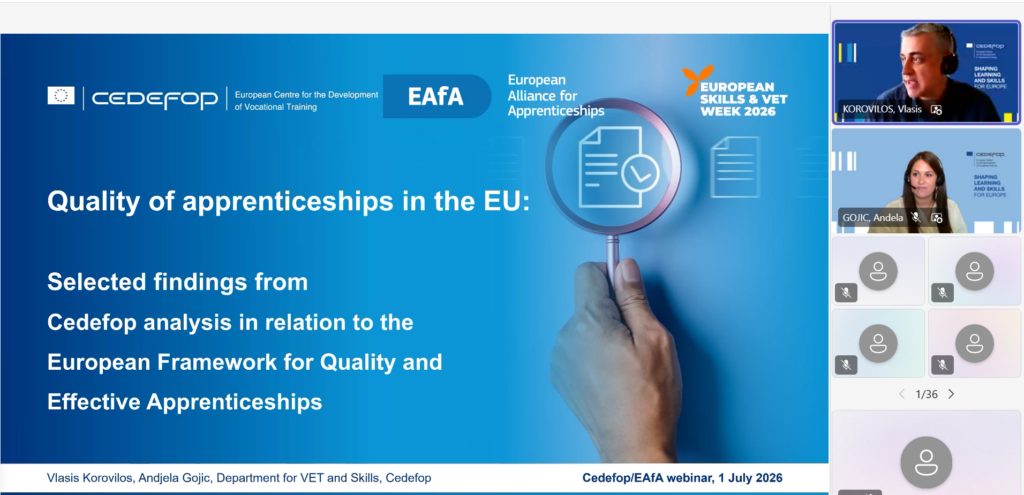
On 1 July 2026, EARLALL participated in the online session “Quality Apprenticeships in the EU”, organised as part of the European Skills and VET Week 2026 by CEDEFOP and the European Alliance for Apprenticeships (EAfA). The event brought together more than 300 participants from across Europe to explore the latest developments in apprenticeship policy, governance and quality assurance.
The session was opened by Antonio Ranieri, Head of Department at CEDEFOP, who welcomed participants and highlighted the importance of cooperation in strengthening apprenticeship systems across Europe. Andrea Leruste from the European Commission’s Directorate-General for Employment, Social Affairs and Inclusion (DG EMPL) underlined the strategic role of apprenticeships in connecting learners with employers and supporting the objectives of the Union of Skills. She recalled that the European Framework for Quality and Effective Apprenticeships is built on two complementary pillars: quality learning and working conditions at workplace level, and supportive legal and institutional frameworks at national and regional level.
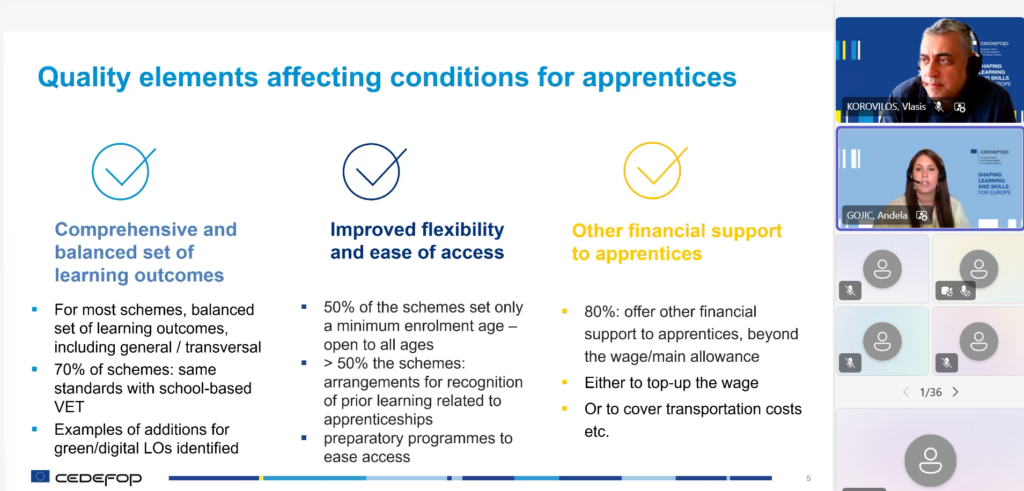
Representing CEDEFOP, Vlasis Korovilos and Anđela Gogić presented key findings from the organisation’s latest cross-country analysis of apprenticeship schemes covering all EU Member States, as well as Norway, Iceland and England. The analysis highlighted significant progress in implementing quality apprenticeships, with most schemes offering written agreements, nationally recognised qualifications and financial compensation for apprentices. At the same time, the speakers identified areas requiring further attention, including pedagogical training for workplace mentors, quality monitoring, company accreditation and stronger support for employers.
The event also featured a panel discussion showcasing different national approaches to supporting apprenticeship quality. Speakers from Finland, Slovenia, Austria, Belgium (Flanders) and Ireland shared how their organisations contribute to developing effective apprenticeship systems.

Among them, Johanna Herrala presented Finland’s learner-centred approach, where apprenticeship pathways are tailored to the needs of both learners and workplaces and supported through the national Association of Apprenticeship Experts. Barbara Krajnc, representing the Chamber of Commerce and Industry of Slovenia, outlined Slovenia’s apprenticeship model and the role of chambers in supporting companies and mentor training. Thomas Moldaschl shared Austria’s long-standing tradition of social partnership through the Federal Council of Vocational Training, while Deborah De Leener explained how EduPlus in Flanders promotes apprenticeship quality through collaboration between employers and employees. Finally, Mairead Boland from Quality and Qualifications Ireland (QQI) presented Ireland’s quality assurance system, highlighting ongoing efforts to streamline apprenticeship approval processes while maintaining high standards.
The learner perspective was brought forward by Amira Bakr from the ODESSU/European Apprentices Network (EAN), who emphasised that quality apprenticeships should extend beyond employability to include mental health, well-being, inclusion and meaningful learner representation. She also presented EAN’s contribution to the Herning Declaration, calling for apprentices to be recognised as formal social partners in vocational education and training policy.
The concluding panel discussion highlighted that, despite the diversity of apprenticeship systems across Europe, several common success factors emerged. Speakers agreed that high-quality apprenticeships rely on strong governance frameworks, close cooperation between education providers, employers and public authorities, qualified workplace mentors, transparent quality assurance mechanisms and meaningful social partner involvement. The discussion also underlined the importance of trust-based collaboration, learner-centred approaches and effective coordination between national institutions to ensure apprenticeship systems remain responsive to evolving labour market needs.
As a member of the European Alliance for Apprenticeships (EAfA) and co-leader of the EAfA Community of Practice on the Role of Regions and Cities in Apprenticeships, EARLALL remains committed to promoting high-quality, inclusive apprenticeship systems across Europe. The discussions also closely align with EARLALL’s role as the communication leader and advisory partner in the QUEEN (Quality apprenticeships for evolving labour needs) project, which aims to empower young people and adults through quality apprenticeships that respond to changing labour market needs and support inclusive and sustainable career pathways.
The event reaffirmed the importance of cross-country learning, strong partnerships and evidence-based policymaking in improving apprenticeship systems. As Europe continues to implement the Union of Skills, exchanges such as these provide valuable insights for regional authorities and education stakeholders working to make apprenticeships more inclusive, resilient and future-oriented.