

Bridging skills gaps for greener futures: Shift Skills presents new competence programme to European stakeholders
25/06/2026
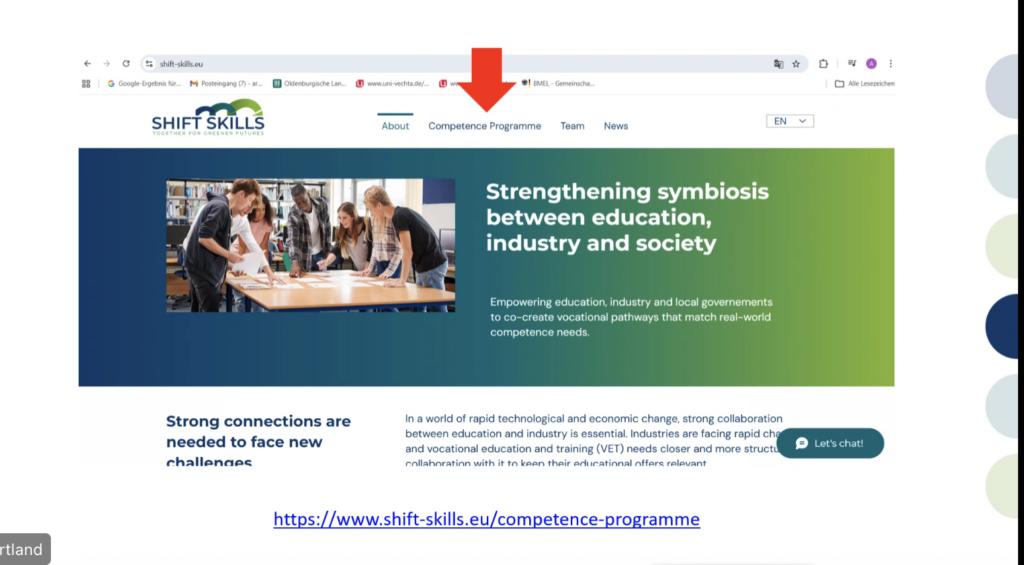
Around 30 participants from across Europe joined an online event on 25 June 2026 to discover the new Shift Skills competence programme and discuss how regions can better bridge the gap between labour supply and demand.
The event was organised within the Shift Skills – Together for Greener Futures project and featured contributions from project partners, including EARLALL member Vestland County Council, as well as representatives from municipalities, education, research and European networks.
The event also marked the appointment of Mr Audun Lysbakken as the new Director of the West Norway House in Brussels, where he officially took over as Director of the West Norway Office, providing an opportunity to reflect on shared European challenges and how regional cooperation can contribute to solving them.
Addressing Europe’s future competence challenges
Opening the event, Tove Hagenes from Alver Municipality, Project Coordinator of Shift Skills, presented the common challenges facing regions across Europe.
The green and digital transitions are creating an urgent need for new skills in areas such as green competencies, digital expertise, technical vocational skills, health and care, and teaching professions. At the same time, demographic change, fewer labour immigrants and changing labour markets are putting additional pressure on regions.
As many current professions continue to transform, while many future professions have not yet been created, education and training systems must become more adaptable. The challenge is not only to educate young people for future jobs but also to support adults and workers in continuously renewing their skills.
The project focuses especially on creating opportunities for young people to access relevant education and employment in their own regions while ensuring that businesses can find the expertise they need.
A practical toolkit for skills development
The central outcome of the Shift Skills project is the Competence Programme, a free online resource designed to support cooperation between businesses, education providers, local governments and students.
The programme provides:
- Free access to digital learning resources
- Practical, ready-to-use tools
- Real-world learning experiences
- Opportunities for knowledge exchange and networking
Presented by Dr Arne Ortland from Trendi Entrepreneurship Service and the University of Vechta, the competence programme includes 24 learning modules and tools developed for different target groups.
The resources are tailored to:
- Industry, supporting businesses in attracting and developing employees with the skills needed for future challenges.
- Education, helping schools and educators prepare learners for changing competence demands.
- Local governments, providing approaches for facilitating cooperation and regional transformation.
The programme combines learning materials with practical transition tools, encouraging users to move from knowledge to action. It supports cross-sector collaboration and helps stakeholders co-create solutions for future skills needs.
Around 750 learners have already engaged with the programme, and the resources will remain available beyond the project period.
The changing role of local governments
During the event, Dick Oudman from Westerkwartier Municipality shared a perspective from the Netherlands on how local authorities can contribute to green transition.
Using housing renovation as an example, he highlighted how ambitious climate objectives depend on having enough skilled workers. Challenges such as limited workforce availability, insufficient training opportunities and the need for new business models demonstrate that the green transition is also a skills transition.
Local governments therefore have an increasingly important role. Rather than only facilitating change, they can act as active drivers of transformation by bringing together businesses, education providers and communities.
From programme to practice: lessons from regions
A panel discussion, moderated by Audun Lysbakken, Director of the West Norway Brussels Office, explored how the competence programme can support real-life transition processes.
The panel included Katrin Jakobsen from Vestland County Council, Tove Hagenes (Alver Municipality) and Iris Rickoff-Fisched (Alexander von Humboldt Foundation).
The discussion focused on the barriers that regions face when developing transition skills.
Tove Hagenes highlighted the need for a stronger sense of urgency. Many organisations continue to work within separate sectors, while today’s challenges require faster action, more cooperation and fewer silos. She emphasised that regions must rethink their role, particularly in areas such as artificial intelligence, security and green transition.
Iris Rickoff-Fisched pointed to the lack of time and space for dialogue between stakeholders. Building mutual understanding and adapting leadership approaches are essential for organisations navigating rapid change.
For Katrin Jakobsen, one of the main challenges is the lack of shared knowledge about future skills needs. Skills development cannot be addressed separately from broader economic and societal changes. Instead, stakeholders must combine their knowledge and work together to create effective solutions.
Making regions attractive for young people
The discussion also highlighted the importance of territorial attractiveness in retaining young people and strengthening regional development.
Tove Hagenes explained that regions need to offer more than education opportunities. Young people also need access to quality jobs, housing, communities and opportunities to build a future locally.
EARLALL highlighted that creating attractive regions also requires close engagement with businesses. Sustainable employment opportunities and good working conditions are essential parts of ensuring that young people choose to stay and contribute to their regions.
A resource for European cooperation
The “Shift Skills competence programme” demonstrates how cooperation between public authorities, education providers and industry can help regions respond to future challenges.
By providing practical tools and supporting structured collaboration, the programme offers municipalities, regions and organisations across Europe a way to strengthen their skills ecosystems and prepare for the green and digital transitions.
The experience of partners such as Vestland County Council shows that successful transition requires shared responsibility, long-term thinking and cooperation across sectors.