

25 Years of Transnational Cooperation in Lifelong Learning
24/06/2026
For twenty-five years, EARLALL has grown from a small group of pioneering regional governments into one of Europe’s most established transnational networks in the field of lifelong learning, skills, and education policy. What started in 2001 as an initiative of nine regions quickly became something more ambitious: a long-term space where regions could work together across borders to shape how Europe learns, trains, and prepares for the future of work.
The founding moment was closely linked to the broader ambitions of the Lisbon Strategy, which set out to make Europe the most competitive knowledge-based economy in the world. From the very beginning, EARLALL’s members shared a simple but powerful conviction: these European ambitions could only succeed if they were grounded in the reality of territories — where education systems, labour markets, and social needs actually come together. Regions were not peripheral actors in this process; they were central to it.
Yet in the early 2000s, regional authorities often lacked a direct channel into European policy design. EARLALL was created to address exactly that gap, giving regions a collective voice and a structured way to engage with EU institutions on lifelong learning policies. This early work quickly evolved into a consistent practice of policy contribution, beginning with structured input into EU programming cycles and culminating in early milestone documents such as the 2003 Cardiff Declaration. This document already contained ideas that would later become mainstream in EU cohesion policy: the need for regionalised implementation, stronger links between education and employment policies, and more integrated use of European funding instruments.
As the network developed between 2004 and 2013, it increasingly focused on making cooperation tangible. Member regions began establishing bilateral agreements that supported real mobility of learners, apprentices, researchers, and workers across borders. At the same time, EARLALL promoted voluntary coordination mechanisms inspired by the Open Method of Coordination, encouraging regions to learn from one another and adapt policy models to their own contexts. This period coincided with the introduction of the EU’s Lifelong Learning Programme, which brought greater coherence to European education initiatives and reinforced the importance of transnational cooperation. EARLALL’s earlier advocacy for programme simplification, regional involvement, and stronger dissemination of results found a natural echo in this new framework.
Over time, the network also helped shape thinking around cohesion policy instruments such as the European Social Fundand later the European Regional Development Fund, consistently arguing that effective skills and employment policies require a territorial approach. Rather than treating regions as administrative implementers, EARLALL promoted the idea of regions as policy co-designers, capable of linking labour market needs, education systems, and innovation strategies in a coherent way.
The years following 2014 brought new challenges and new areas of focus. As Europe recovered from the sovereign debt crisis and faced rising youth unemployment, attention turned to the integration of policies supporting young people. EARLALL actively contributed to discussions around the EU Youth Guarantee, advocating for a broader understanding of youth transitions that went beyond employment alone. Projects such as “One Step Ahead” reflected this holistic approach, combining education completion, skills development, social inclusion, housing independence, and income support. The underlying idea was clear: transitions into adulthood are complex, and policy responses must reflect that complexity.
A major turning point came in 2015, when the Basque Country assumed the EARLALL presidency. Over the following decade, the network experienced a period of institutional consolidation and increased European visibility. Its Secretariat was strengthened, its governance structures were modernised, and its policy engagement expanded significantly. EARLALL became an active contributor to major EU initiatives such as the Skills Agenda and the Erasmus+ framework, while also participating in platforms including the Pact for Skills and other European skills alliances. This period also marked a deeper engagement with institutions such as the Committee of the Regions, reinforcing EARLALL’s role as a bridge between regional realities and European policymaking.
The COVID-19 pandemic in 2020 tested the resilience of the entire education and training ecosystem. For EARLALL, it became a moment of rapid adaptation. The network shifted entirely to digital formats, maintaining its activities without interruption and reinforcing its focus on digital skills, online learning, and system resilience. Rather than slowing down cooperation, the crisis accelerated it, demonstrating the importance of strong transnational networks when systems are under pressure.
In 2023, during the European Year of Skills, EARLALL further strengthened its role as a convener of regional expertise. High-level events brought together policymakers and practitioners to discuss vocational excellence, green and digital transitions, inclusion, and mobility. At the same time, partnerships with organisations such as OECD and UNESCOexpanded the network’s international reach, reinforcing its position in global discussions on skills and lifelong learning.
More recently, the emergence of the Union of Skills has opened a new strategic phase for EARLALL. The initiative places skills at the centre of Europe’s competitiveness agenda, and EARLALL has actively contributed to shaping its direction through consultations, policy dialogue, and direct engagement with European institutions. A consistent message runs through this work: regions are not simply implementers of skills policies — they are co-creators of them, because they are closest to learners, employers, and local ecosystems.
At the same time, discussions around the next Multiannual Financial Framework (2028–2034) have highlighted the importance of protecting the territorial dimension of EU funding. EARLALL has advocated strongly for maintaining decentralised implementation structures within programmes such as Erasmus+, warning that excessive centralisation would weaken the capacity of policies to respond to diverse regional needs. Early signs from the legislative process already show increasing recognition of the regional role in shaping future programme design.
Alongside its policy work, EARLALL remains a highly active cooperation platform. Through initiatives such as the EARLALL Academy, mobility matchmaking tools, and sectoral skills exchanges, the network continues to connect practitioners across Europe. Its members are currently involved in multiple projects funded under programmes such as Horizon Europe, Erasmus+, Interreg Europe, and ESF+, ensuring that policy ideas are constantly tested and refined through practice.
Looking ahead, EARLALL enters its next phase with both continuity and urgency. Continuity, because its founding belief — that education and skills policy must be rooted in territories — remains unchanged. Urgency, because Europe is currently redefining its skills architecture for the coming decade, and the balance between centralisation and regional ownership is once again under discussion.
After twenty-five years, EARLALL’s trajectory is not just a story of institutional growth. It is a story of sustained cooperation across borders, of policy ideas developed through practice, and of regions steadily asserting their role in shaping Europe’s future. As the next chapter begins, the question is not whether regions matter in lifelong learning — but how Europe chooses to embed that reality in its policies going forward.
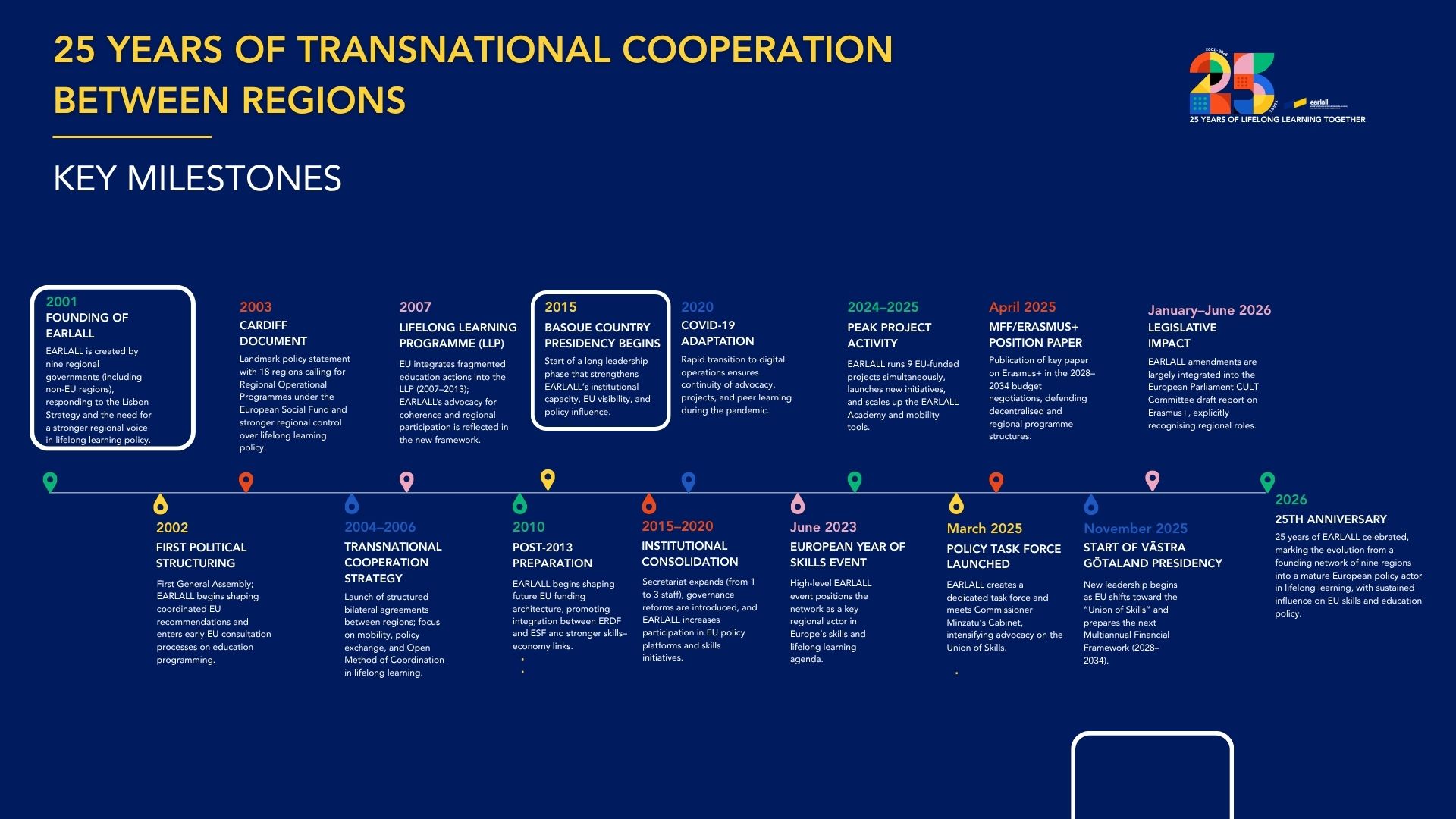
To explore the full historical narrative, milestones, and policy developments in detail, you can consult the complete publication below:
With the contributions from Paolo Federighi, Hon. prof at the University of Florence