

EARLALL Participates in the ZainLab Event at the European Parliament
08/06/2026
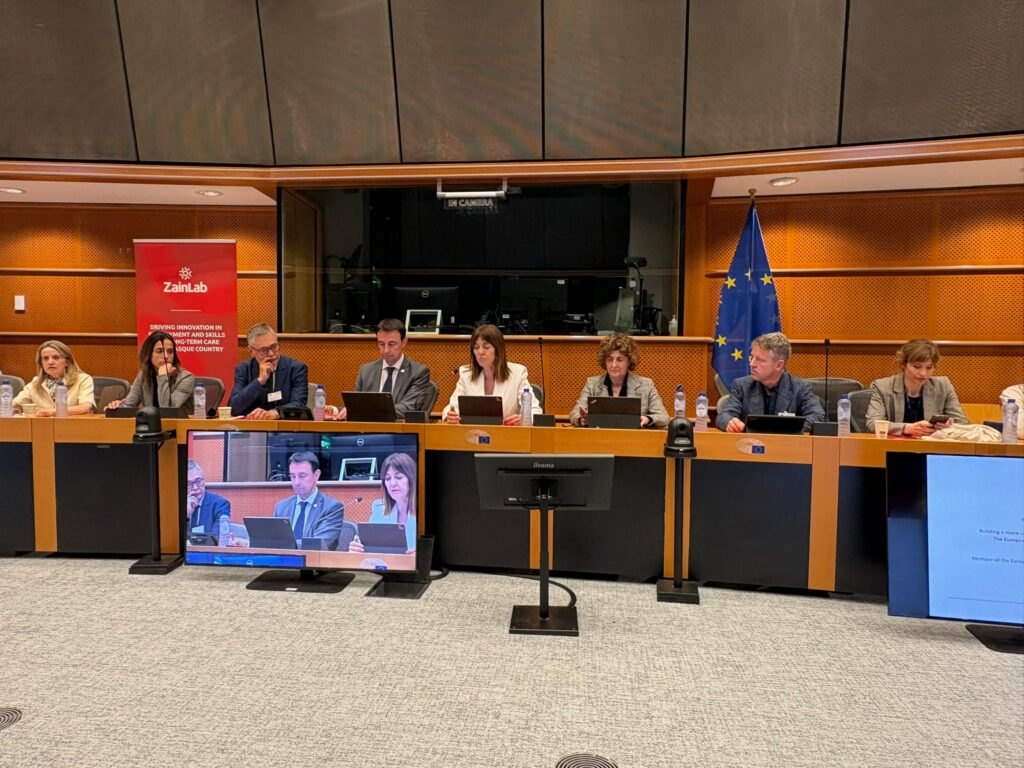
On 3 June 2026, EARLALL participated in the event “ZainLab Regional Skills Partnership: Bringing the Basque Experience to the European Union”, organised by the Basque Country, a long-standing member of the EARLALL network, at the European Parliament in Brussels. The event brought together European policymakers, regional authorities and care sector stakeholders to discuss the future of care, employment and skills development in the context of demographic ageing.
ZainLab is a multi-year programme launched by the Basque Government’s Department of Economy, Labour and Employment and implemented by Grupo SSI. Developed as part of the Basque Employment Strategy 2030, the initiative addresses the challenges and opportunities arising from the ageing of the Basque population and the growing importance of the care economy.
Building a More Caring Europe
The event was opened by Idoia Mendia, Member of the European Parliament and ZainLab Ambassador, who emphasised the need to rethink and reshape care systems across Europe. She highlighted that care has traditionally been perceived as a private responsibility, often carried out by women and insufficiently recognised as a strategic sector.
According to Mendia, the challenge is not only to expand care provision but also to create a more sustainable, fair and inclusive care model. She stressed the importance of investing in training, skills development and professional mobility while recognising care as a strategic sector for Europe’s future. She described ZainLab as a valuable example of how regions can anticipate future challenges, create alliances and share innovative practices with others.
The Basque Government’s Strategic Approach
Mikel Torres, Vice-President and Basque Minister of Economy, Labour and Employment, presented the Basque Government’s strategic approach to care and employment in the face of demographic change.
He underlined that care is both a European and a local strategic priority requiring a more ambitious and holistic approach. He argued that quality care cannot exist without quality jobs and highlighted the strong link between care policies and gender equality.
Torres stressed the need for lifelong learning opportunities, upskilling and reskilling pathways, as well as technological and social innovation. Improving quality of life and ensuring better working conditions for care workers must go hand in hand. He also emphasised the importance of cooperation between regions and European partners to scale up successful initiatives and share experiences across Europe.
Five Years of ZainLab: Lessons Learned and Future Perspectives
Sara Buesa, Director of Inclusion of the Basque Government, and Karmele Acedo, CEO of Grupo SSI, reflected on five years of ZainLab implementation.
They highlighted three key priorities: professionalisation, upskilling and talent attraction within the care sector. The speakers stressed that the future of care requires anticipating emerging skills needs linked to digitalisation, demographic change and the green transition.
Sara Buesa explained that one of ZainLab’s greatest achievements was moving beyond diagnosis and consultation towards concrete action. Through collaboration with stakeholders, the initiative developed new training pathways, new professional profiles and innovative approaches to workforce development.
Karmele Acedo presented ZainLab as a long-term innovation ecosystem. She explained that the project began with an extensive mapping and consultation process involving a wide range of stakeholders before moving into pilot projects and practical experimentation. Through innovative training and mentoring activities, more than 800 people participated in learning pathways designed to strengthen skills and professional recognition in the care sector. She also emphasised the importance of aligning regional initiatives with broader European frameworks such as the Pact for Skills and the Union of Skills.
Both speakers stressed that transforming the care sector requires professional recognition, stronger labour rights, innovative pedagogical approaches and a commitment to anticipating future workforce needs.
The European Perspective
The European dimension of care and employment was presented by Dana-Carmen Bachmann, Head of Unit for Social Protection and Demography at DG Employment, Social Affairs and Inclusion (DG EMPL), European Commission.
She presented the European Care Strategy, adopted in 2022, which aims to strengthen care systems across Europe and improve access to high-quality, affordable long-term care. Particular attention is being given to workforce development, improved working conditions, social dialogue and support for informal carers.
Bachmann also highlighted a range of European funding opportunities supporting care-related initiatives, including the Recovery and Resilience Facility, Cohesion Policy Funds, Erasmus+, Horizon Europe, Digital Europe and EU health programmes. Looking ahead, she presented the upcoming European Care Deal, which will focus on workforce challenges, quality of care and access to services.
She called on stakeholders to continue making the care sector more visible within European policy discussions and highlighted the relevance of the Union of Skills, skills portability initiatives and fair labour mobility measures.
The practical implementation of European priorities was further explored by Alessia Sebillo, Head of Knowledge and Innovation at EASPD (European Association of Service Providers for Persons with Disabilities).
She presented the Large-Scale Partnership for Long-Term Care under the Pact for Skills, which brings together stakeholders from across Europe to address skills shortages and workforce challenges in the care sector. The partnership aims to train 60% of long-term care professionals annually by 2030 and focuses on digital skills, person-centred approaches, research and innovation.
Sebillo also highlighted the benefits of participation in European partnerships, including access to innovative resources, lifelong learning opportunities, networking and knowledge exchange.
Looking Towards the Future
The event concluded with remarks from Alfonso Gurpegui, Basque Deputy Minister for Employment and Inclusion.
He explained that although the Basque Country is a relatively small region, it seeks to contribute to European discussions and learn from other territories facing similar challenges. He recalled that the COVID-19 pandemic exposed the fragility of the care sector and reinforced the need for long-term investment and innovation.
Since its launch, the Basque Government has invested approximately €2.6 million in the development and implementation of ZainLab, supporting analysis, experimentation and innovation activities. Looking ahead, the initiative aims to strengthen its European dimension, continue developing innovative methodologies and contribute to the transformation of the care sector across Europe.
The event demonstrated how regional initiatives such as ZainLab can contribute to European debates on care, skills and employment while providing valuable lessons for policymakers and practitioners seeking to build more sustainable and inclusive care systems.