

WISE Webinar Series Launches to Promote Holistic Support for Refugee Women Across Europe
12/05/2026
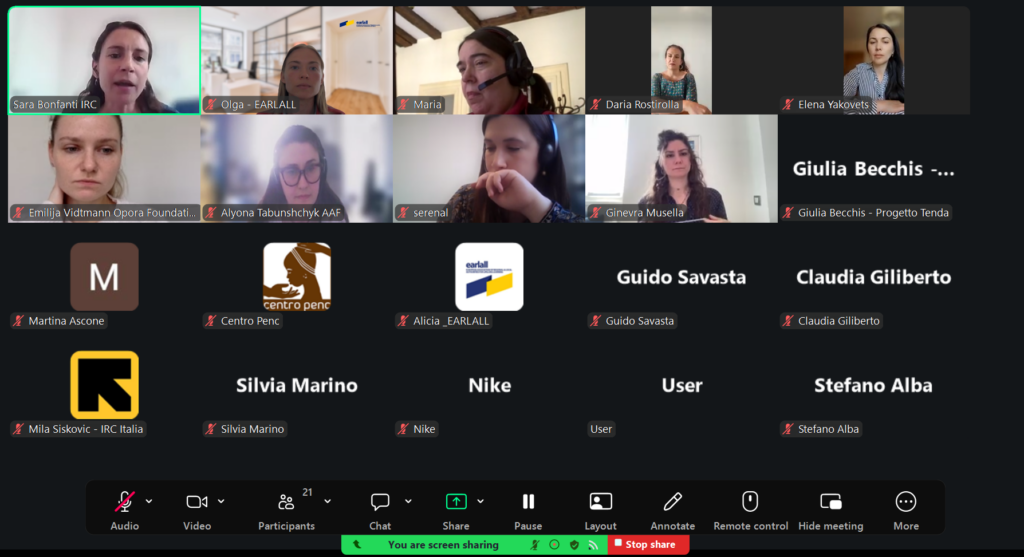
On 12 May 2026, the WISE (Supporting Ukrainian Refugee Women’s Socio-Economic Integration and Wellbeing) project launched its Webinar Series, bringing together 32 participants from across Europe to explore holistic approaches to refugee women’s integration and wellbeing. The webinar was hosted and coordinated by EARLALL, the project’s communication, dissemination and scale-up leader.
Organised within the framework of the ESF+ funded WISE project, the webinar series aims to present the Holistic Support Centre (HSC) model, share experiences and case studies from implementation sites in Turin, Milan, Rome and Sofia, and encourage the replication of this integrated approach in different European contexts.
The series targets municipalities and regional authorities, NGOs working with migrants, social enterprises, employment and integration services, as well as women’s safe spaces and community centres.
Introducing the Holistic Support Centre Model
The first webinar, entitled “Implementing the Holistic Support Centre (HSC) and Ethnopsychology Approaches in the Integration of Refugee Women: From Concept to Practice”, introduced participants to the WISE project and explored how integrated and multi-dimensional services can support the socio-economic inclusion and wellbeing of refugee women.
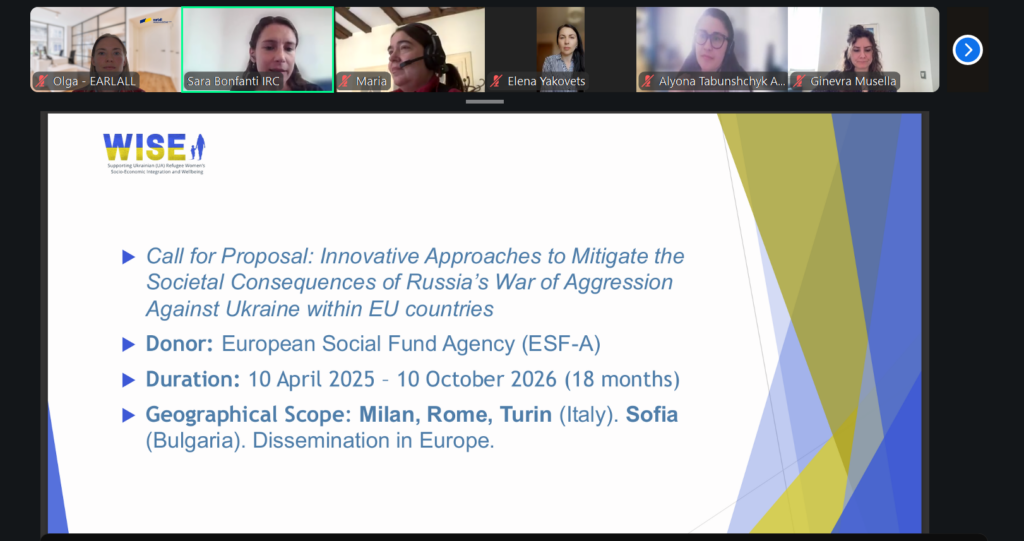
Opening the session, Sara Bonfanti, Head of Programmes at the International Rescue Committee (IRC) Italy and WISE Project Coordinator, presented the WISE project and its objectives. Funded under the call “Innovative Approaches to Mitigate the Societal Consequences of Russia’s War of Aggression Against Ukraine within EU Countries”, the project is being implemented in Milan, Rome and Turin (Italy) and Sofia (Bulgaria), while dissemination activities are carried out across Europe.
She highlighted that WISE aims to improve the socio-economic inclusion of employable refugee women from Ukraine through an integrated support model that combines employability, social inclusion and psychosocial wellbeing.
From Concept to Practice
Participants gained practical insights into how Holistic Support Centres are established and operated.
Maria Tchomarova, Mental Health Expert, Senior Psychologist and Psychoanalyst at Animus Association Foundation (Bulgaria), presented the key components of the HSC model, emphasising the importance of multidisciplinary cooperation between cultural mediators, facilitators, case workers and psychologists to provide effective and trauma-informed support.
The webinar also explored how safe and inclusive spaces can be created within local communities. Daria Rostirolla, from Laboratorio di Gruppoanalisi (LdG) in Rome and collaborator with Centre Françoise Minkowska, shared the experience of implementing the Rome Holistic Support Centre and highlighted the crucial role of cooperation with local authorities. She demonstrated how collaboration with the Municipality of Rome strengthened access to services, increased public legitimacy and facilitated referrals between the Centre and municipal social services.
She shared the experience of implementing the Rome Centre and highlighted the essential role of cooperation with the Municipality of Rome. A formal agreement signed in September 2023 between Laboratorio di Gruppoanalisi and the II Municipality of Rome enabled the organisation to receive premises free of charge for both the Safe Space and the Clinical Centre.
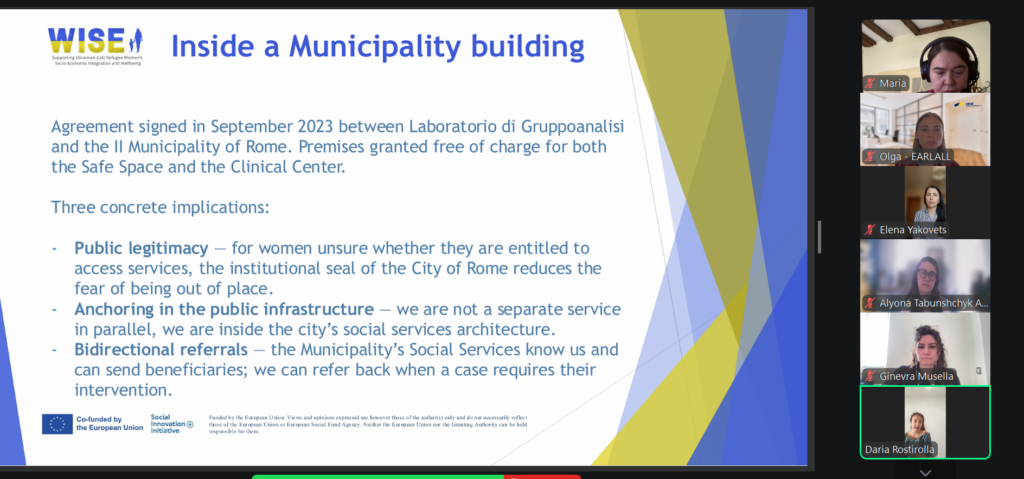
The collaboration with the municipality created three concrete advantages:
- Public legitimacy for women uncertain about their entitlement to access services
- Strong anchoring within the city’s public social services infrastructure
- Bidirectional referrals between municipal services and the Centre
Culture, Trauma and Mental Health
The final presentation was delivered by Gineva Musella, Psychologist and Psychotherapist at Centro PENC – Anthropology and Geoclinical Psychology (Milan), who introduced participants to ethnopsychiatry and culturally sensitive approaches to mental health support.
Her presentation explored how psychology and anthropology can be combined to better understand the impact of culture on identity, relationships, emotional wellbeing and perceptions of illness and healing. The session highlighted the importance of culturally informed support in addressing the complex experiences of refugee women.
The webinar concluded with an engaging discussion and exchange of experiences among participants.
Continuing the WISE Webinar Series
The WISE Webinar Series explores practical and holistic approaches to supporting the socio-economic integration and wellbeing of refugee women across Europe. Through presentations from practitioners, psychologists, municipalities, and project partners, the sessions share experiences from the implementation of the Holistic Support Centre (HSC) model in Italy and Bulgaria. Participants gain insights into topics such as psychosocial support, ethnopsychology, skills profiling, labour market integration, community-based initiatives, and the replication of gender-sensitive support models in different local contexts. More information and registration here.
Access the first webinar recording and presentation.
Municipalities, regional and local authorities, lifelong learning providers, employment services and organisations interested in replicating the Holistic Support Centre (HSC) model are strongly encouraged to join the final webinar of the WISE Webinar Series, “Replicability of a Gender-Sensitive and Holistic Approach for Refugee Women’s Integration”, taking place on 22 June 2026 from 12:30 to 13:30 CET.
The session will explore how holistic and gender-sensitive approaches can be successfully adapted and implemented across different organisational contexts, while sharing practical experiences, challenges and success factors from the field.