

Working in the Age of AI: Eurofound Presents Key Findings at the European Parliament
22/04/2026
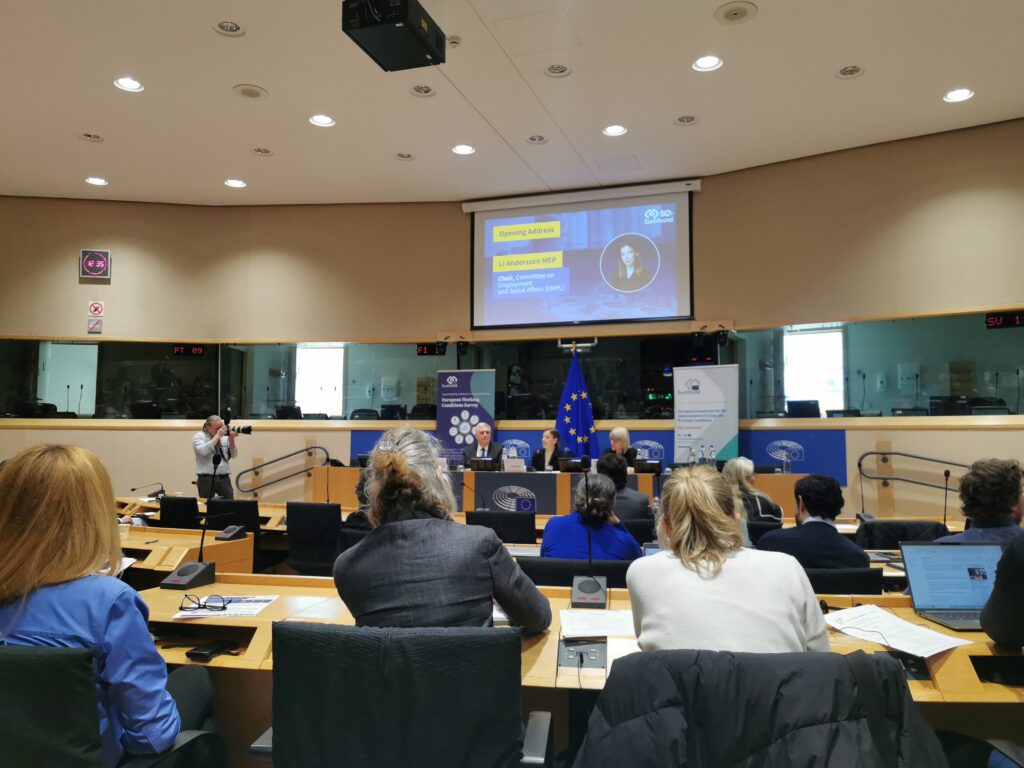
On 21 April 2026, EARLALL participated in Eurofound’s event “Working in the Age of AI – How are working conditions changing across Europe?” held at the European Parliament. The gathering brought together national policymakers, social partners, civil society representatives and experts to discuss the latest evidence from Eurofound’s European Working Conditions Survey (EWCS) Overview Report and to explore how data can inform sustainable policies on job quality, fairness and competitiveness in the future of work.
The event opened with an address by Li Andersson, MEP and Chair of the Committee on Employment and Social Affairs (EMPL). She underlined that the role of AI in the workplace is a central topic in parliamentary debates, with policymakers striving both to mitigate risks, such as the blurring of boundaries between work and private life, and to harness technological progress to create new opportunities, particularly for vulnerable groups.
Moderation was provided by Barbara Gerstenberger, Head of the Working Life Unit at Eurofound, who introduced the agenda and speakers. Giving the floor to Ivailo Kalfin, Executive Director of Eurofound, she invited him to highlight the unique scope of the EWCS dataset, which provides an unparalleled evidence base for advancing job quality across Europe.
Kalfin welcomed Agnès Parent‑Thirion and Jorge Cabrita, Senior Research Managers at Eurofound’s Working Life Unit, who presented the report’s methodology and key findings. Parent‑Thirion noted job quality as a key factor in reducing stress levels, improving public health and maintaining a motivated workforce up to the age of 60. She emphasised that job quality is a cornerstone of Europe’s long‑term competitiveness. The report identifies seven dimensions that shape working life, several of which, such as working time quality, prospects, the physical environment and skills and discretion, have shown improvement in recent years. Skills and discretion were highlighted as particularly significant, with learning opportunities and workplace training emerging as essential components of high‑quality work.
Cabrita then addressed the dimensions requiring further attention. The social environment remains a concern, with women reporting higher exposure to discrimination than men. Organisational participation has declined over time, and work intensity has increased, with more workers required to manage emotionally demanding situations. Cabrita concluded by stressing that working conditions vary considerably by occupation, age, gender and sector, and that improved job quality is closely linked to access to unions and collective representation.
The discussion continued with contributions from Francesco Corti, Member of Cabinet to the Executive Vice‑President for Social Rights, Skills, Quality Jobs and Preparedness at the European Commission. Corti highlighted concerns about workers’ exposure to emerging risks, including rising temperatures, and the decline of workplace representation structures. Laura Nurski, Head of the Future of Work Programme at the Centre for European Policy Studies (CEPS), echoed this view, describing the report’s methodological depth as setting a global benchmark. She drew attention to the nuanced patterns revealed across Member States, particularly regarding polarisation in working conditions. Marit Maij, MEP and member of the EMPL Committee, emphasised the persistent gender gap as a significant challenge for the EU. The contributions from the Parliament underscored the value of the EWCS report as a foundation for strong and sustainable policymaking.
In their closing remarks, Ivailo Kalfin and Li Andersson reiterated the central message of the event: that Europe’s competitiveness lies at the intersection of technological innovation, organisational practices and workers’ wellbeing. As a network committed to inclusive and high‑quality working environments, EARLALL welcomed the insights shared and the continued focus on shaping a fair and sustainable future of work, strengthening regional learning ecosystems and contributing to Europe’s long‑term competitiveness.