
Working Groups on Youth Policies and Lifelong Guidance & Ageing Societies
20/03/2026
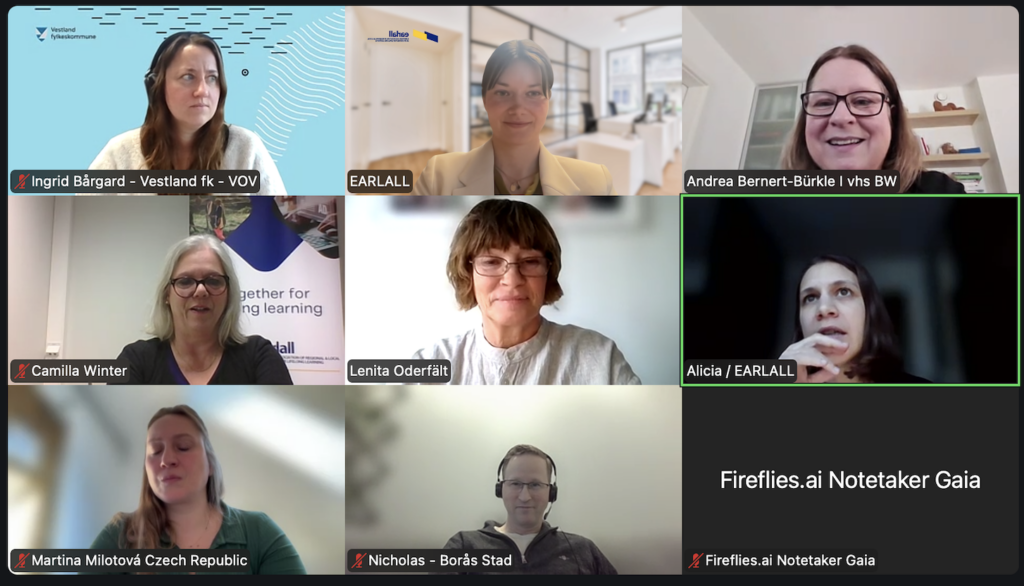
The EARLALL Working Groups on Youth Policies and Lifelong Guidance & Ageing Societies concluded the first round of meetings for 2026. These sessions, held quarterly, brought together policy representatives, public authorities, and technical staff from EARLALL member regions and associate members to discuss upcoming activities, webinars, and to consolidate plans for the upcoming EARLALL 25th Anniversary.
On 12 March 2026, the Working Group on Lifelong Guidance & Ageing Societies, hosted by Baden-Württemberg in cooperation with Camilla Winter AB, highlighted upcoming activities explore potential synergies with other organizations. The session also showcased the next transnational peer learning event of the SALAM (Sustainable Accessibility to the Labour Market) project, taking place in June 2026, Sweden.
The group further reviewed activities within the Lifelong Guidance 5.0 project. In particular, the conference Lifelong Changes: Transformations in Career Guidance and Counselling, to be held on 22-23 March 2026 in Vienna. This conference will address challenges arising from technological innovations, evolving labour markets, and societal developments, with a special focus on vulnerable groups. Framing challenges as opportunities, the conference will examine how technology can support workforce development and investigate competence validation as a potential solution. The programme will conclude with two additional days dedicated to modular training open for participation.
Guest speaker Lenita Oderfält from the Nordic Academy of Textiles presented insights in skills development and validation within HVET (Higher Vocational Education and Training), opening opportunities for international collaboration. Discussions also explored how to integrate micro-credentials effectively, laying the groundwork for the upcoming EARLALL Academy on Micro-credentials and Individual Learning Accounts, scheduled for April.
On 17 March 2026, the Working Group on Youth Policies met, chaired by Miriana Bucalossi from the Tuscany Region. The meeting opened with updates on ongoing projects.
- QUEEN project (Quality Apprenticeships for Evolving Labour Needs) next partner meeting will take place in South West Finland on 20–21 May 2026, where a capacity-building module on apprenticeships will be presented within the framework of EFQEA.
- SKYLA project (Smart Specialisation Skills Ecosystems for the Twin Transition) next partner meeting is scheduled for 5–6 May 2026 in Athens, Greece.
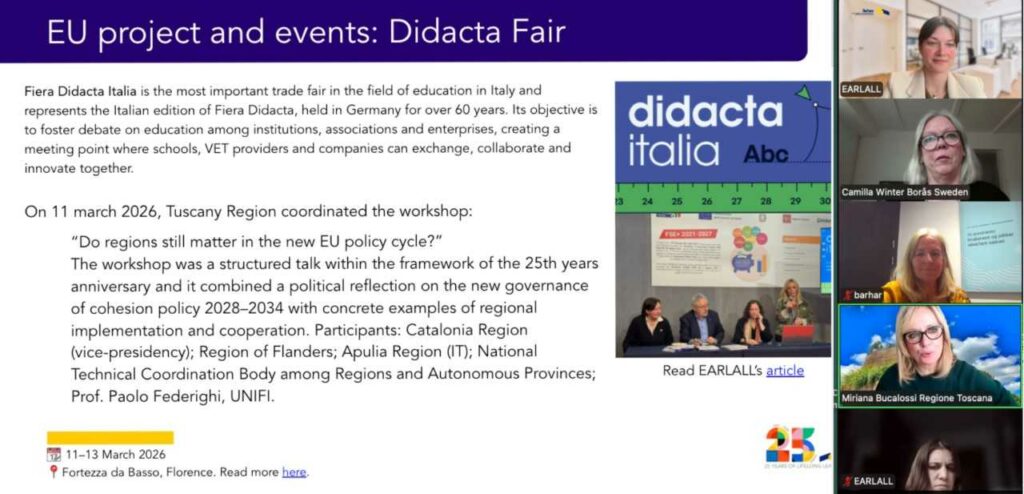
Bucalossi also presented EARLALL’s seminar at Didacta Fair, one of the most important trade fairs in education. The event fosters dialogue among institutions, associations, and enterprises, creating a space where schools, VET providers, and companies can exchange ideas and collaborate. Within this framework, the session “Do Regions Still Matter in the New EU Policy Debate?” combined political reflections on the governance of cohesion policy 2028–2034 with concrete examples of regional implementation and cooperation, highlighting EARLALL’s 25th Anniversary.
The meeting also addressed the European Commission’s a plan against cyberbullying, which was launched on 10 February on the Safer Internet Day and the strategy on intergenerational fairness (March 2026), which aims to ensure that today’s choices contribute positively to future opportunities. This cross-cutting approach evaluates public decisions based on their impact on present and future generations through three pillars: fair policymaking, fair opportunities, and fair places. A key example of this strategy is European Youth Week 2026, focusing on solidarity and fairness.
Both working groups exchanged ideas for capacity-building webinars and identified potential topics for sessions during the 25th Anniversary.. Through these Working Groups, EARLALL continues to strengthen collaboration between regions, supporting the development of activities that promote inclusive and lifelong learning.