
Boosting Talent Through Innovation, Skills and Quality of Life
12/03/2026
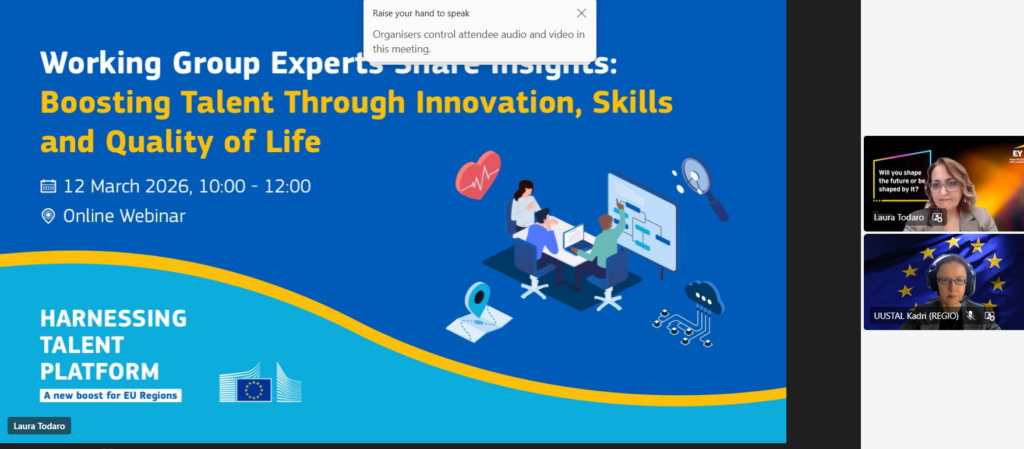
On 12 March 2026, experts and policymakers gathered for the event “Talent Booster Mechanism (TBM) Working Group Experts Share Insights: Boosting Talent Through Innovation, Skills and Quality of Life”, organised in the framework of the Talent Booster Mechanism (TBM) under the European Commission Directorate-General for Regional and Urban Policy (DG REGIO).
The event marked the conclusion of two and a half years of collaborative work, bringing together 88 experts from 22 European countries across regional authorities, research institutions, industry and policy organisations, including EARLALL. The TBM initiative explored ways to address demographic challenges and talent shortages, particularly in regions facing population decline or difficulties in attracting and retaining skilled people.
Innovation and digitalisation for regional talent
The first session focused on innovation and digitalisation as key drivers of regional transformation. A self-assessment tool, developed by the Digital and Research & Innovation Working Groups, was presented to help regions evaluate their readiness to attract, retain, and develop talent. The tool identifies strengths and gaps across innovation ecosystems, governance, skills systems, and essential services, allowing regions to reflect and compare themselves with peers.
Speakers highlighted ongoing challenges, including infrastructure and connectivity gaps, especially in rural areas, and a mismatch between digital skills supply and labour market demand. Strengthening collaboration among training providers, public authorities, and employers was emphasised as critical for building effective regional digital skills ecosystems.
Another key output was a practical guide for SMEs, providing strategies and examples to help small and medium-sized enterprises adopt digital solutions, enhance innovation, and strengthen regional economic resilience.
Knowledge valorisation and place-based skills strategies
The event also showcased the Toolkit on Knowledge Valorisation at the Regional Level, developed by the Research & Innovation Working Group with contributions from EARLALL. Presented by ART-ER Attractiveness Research Territory (Emilia-Romagna), the toolkit offers guidance on transforming research into economic and societal value, highlighting governance models, collaboration mechanisms, and skills needed for innovation ecosystems.
Complementing this work, TBM experts presented policy recommendations on assessing skills needs and developing skills within place-based innovation strategies. Recommendations emphasised inclusive, participatory skills ecosystems, focusing on STEAM approaches, talent retention, recognition of non-formal learning, and governance structures to address territorial disparities.
Initiatives such as LCAMP – Learner Centric Advanced Manufacturing Platform and its jobs and skills observatory were highlighted as examples of how regions can combine lifelong learning, strategic partnerships, and knowledge sharing to anticipate labour market needs and strengthen local talent development.
Quality of life and inclusive regions
Beyond innovation and skills, the discussions stressed that talent development depends on the quality of life and access to essential services. Inclusive societies, healthcare, education, and social infrastructure were presented as critical factors enabling regions to attract and retain talent, supporting the concept of the “right to stay”.
Continuing the conversation
Although the working group activities have officially concluded, the dialogue initiated through the TBM will continue. As noted by François Gallaga, Team Leader at DG REGIO, the conversation among regions, policymakers, and experts remains essential to addressing Europe’s demographic and talent challenges. This exchange will culminate in a final in-person event on 28 May in Brussels, reflecting on outcomes and next steps for regional talent development initiatives.