

EARLALL participates in the 16th Large-Scale and Regional Skills Partnership Coordinators’ Technical Meeting
04/03/2026
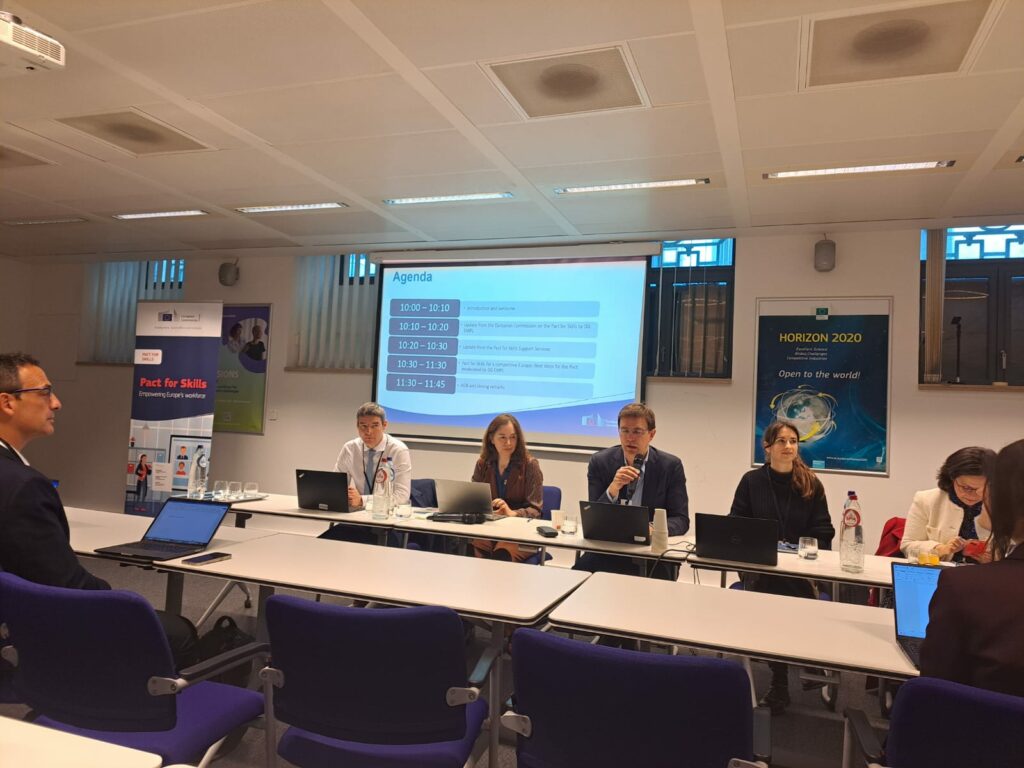
On 3 March 2026, EARLALL took part in the 16th Large-Scale Skills Partnership (LSP) and Regional Skills Partnership (RSP) Coordinators’ Technical Meeting of the Pact for Skills. The meeting was hosted by the European Commission in Brussels and was held ahead of the 2026 European Employment and Social Rights Forum.
As coordinator of the Regional Skills Partnership for Lifelong Learning Mobility, Noelia Cantero, Director of EARLALL, contributed to discussions on the future implementation of the revamped Pact for Skills within the framework of the Union of Skills.
Driving Forward the Union of Skills
The meeting opened with remarks from Steven Engels, Head of Unit for Professional Qualifications and skills for Competitiveness, DG EMPL, outlining the ambitions for LSPs and RSPs in advancing the Union of Skills. Updates were provided on the operation and delivery of the Pact, followed by an exchange with coordinators.
The Commission highlighted the scale of the initiative, which currently brings together:
- 20 Large-Scale Skills Partnerships
- 22 Regional Skills Partnerships
- Over 4,000 member organisations
Particular emphasis was placed on strengthening cross-sectoral synergies, improving linkages between partnerships, and reinforcing upskilling and reskilling commitments. The alignment of the Pact with the EU Competitiveness Compass and the future Multiannual Financial Framework (MFF) was identified as a strategic priority, with further financial support for VET–business cooperation expected under the Competitiveness Fund in 2028 onwards.
Three Major Policy Updates
The Commission also presented three key policy developments shaping the future EU skills agenda:
- New VET Strategy
Building on the Herning Declaration, the upcoming VET Strategy will revise and update the current framework. An open public consultation is ongoing, with the final document expected in June 2026. - European Skills Academies
The Academies will be integrated into the new VET Strategy. They are intended to function as a more operational and practical instrument, guiding both the Commission and implementing agencies in their deployment. - Skills Portability and Recognition
The Commission emphasised the need to strengthen the Single Market for skills by improving the use of existing transparency frameworks, addressing challenges in regulated professions, and facilitating recognition of qualifications — including for third-country nationals.
Participants also expressed interest in contributing to the newly established European Skills Intelligence Observatory under the Union of Skills, highlighting the importance of better skills intelligence and anticipation mechanisms.
Pact Support Services and Operational Tools
An update from the Pact for Skills Support Services, implemented by Ecorys, presented ongoing activities including monitoring exercises, the annual survey, and funding-related webinars for Pact members.
The Pact toolkit was highlighted as a central implementation instrument, encompassing:
- Blueprints for sectoral cooperation
- The new VET–Business strand
- EU Skills Academies
- EU Alliances
Stronger coordination between the Pact for Skills and the European Alliance for Apprenticeships was also discussed, particularly in relation to common services and apprenticeship-related pledges.
EARLALL also supports the work of the EAfA in several concrete ways, as a long‑standing EAfA member and pledge contributor, active participation in EAfA events and webinars, co‑lead of an EAfA “Community of Practice on the Role of Cities and Regions in Fostering Apprenticeships”, and Policy support and content contributions.
Next Steps: Boosting Pledges and Enhancing Impact
The core of the meeting consisted of an interactive roundtable discussion on the role of Pact partnerships in achieving the objectives of the revamped Pact for Skills for a competitive Europe. Exchanges focused on:
- Boosting and improving the monitoring of pledges, including apprenticeships
- Expanding membership, particularly among SMEs and regional actors
- Strengthening skills intelligence and anticipation systems
- Improving the effectiveness of Pact support services