

EARLALL attended Cedefop webinar on National Qualifications Frameworks
09/12/2025
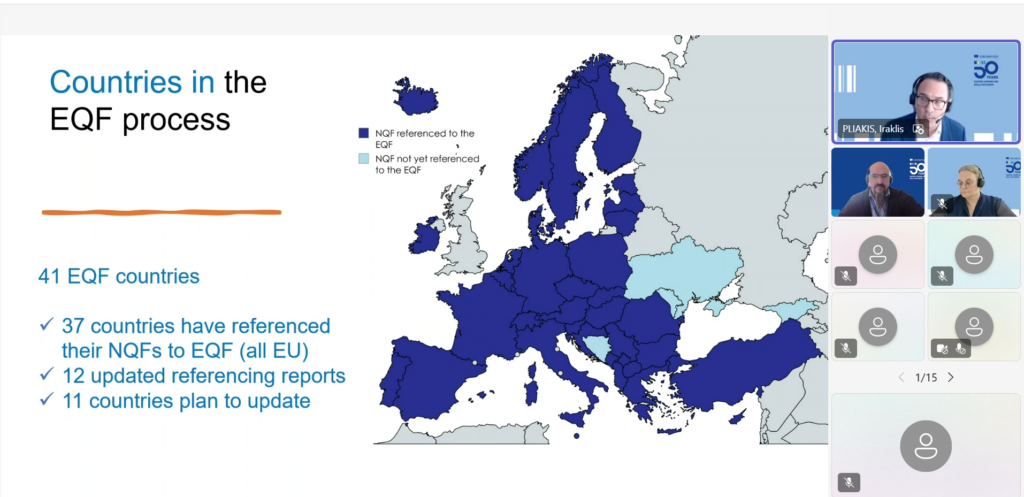
Today, EARLALL took part in Cedefop’s online webinar “National qualifications frameworks in action: What is their potential for the Union of Skills?”. The session gathered more than 250 participants and offered policy-makers, stakeholders, experts and the wider public an opportunity to deepen their understanding of the evolution of National Qualifications Frameworks (NQFs) and current trends across countries participating in the European Qualifications Framework (EQF) process. Cedefop also presented the latest findings from its research and analysis, together with the updated version of the NQF online tool.
The webinar opened with introductory remarks by Irene Mandl, Head of Department at Cedefop, who welcomed participants and Deputy Director Mara Brugia. Brugia highlighted that this webinar forms part of Cedefop’s 50th anniversary activities, recalling that since its establishment the agency has contributed significantly to making people’s skills and qualifications more visible and comparable across Europe. She underlined Cedefop’s longstanding support to the EQF through research, data collection and policy analysis.
A contribution from Nomden Koen (DG EMPL, European Commission) emphasised that national qualifications frameworks are not merely technical instruments. Learning outcomes – what individuals know, understand and can do, regardless of how or where learning takes place – remain central to the design and use of qualification frameworks. These frameworks foster lifelong learning, support skills development, and enhance transparency and trust across labour markets. Today, all EU Member States have referenced their national frameworks to the EQF. Koen also noted the role of NQFs in validating skills acquired outside formal education, strengthening the attractiveness of European qualifications to third countries, and contributing to the EU’s broader Union of Skills initiative. A key component of this initiative is the forthcoming Skills Portability Initiative, planned for adoption in 2026, which aims to reduce barriers to mobility and improve the recognition and comparability of skills across Europe. A public consultation on the initiative has now been launched.
Insights from Cedefop’s presentations on NQF developments
During the webinar, expert in qualifications and credentials at Cedefop – Iraklis Pliakis, presented an overview of progress across the 41 countries participating in the EQF process. To date, 37 countries have referenced their National Qualifications Frameworks (NQFs) to the EQF. He outlined how Cedefop, the European Training Foundation (ETF), the European Commission and EQF countries collaborate to collect, analyse and update information on national qualification systems, ensuring that the EQF remains accurate and comparable across Europe.
NQFs are increasingly used to support the design and review of qualifications, improve quality assurance, and facilitate the recognition of foreign qualifications. Their use in labour markets is growing, with 18 countries applying NQF levels in recruitment processes. Key impacts include greater transparency and comparability of qualifications, stronger lifelong learning pathways, enhanced international mobility, and improved alignment between education and labour market needs.
Looking ahead, priorities include raising awareness of NQFs, expanding their coverage, and strengthening databases that support visibility and use. Theocharous Aristos presented the updated NQF online tool – an interactive platform enabling users to explore and compare NQFs across 41 countries and understand how qualifications relate to the EQF.
National perspectives
Croatia
Josipa Cesnovar presented Croatia’s experience with implementing the NQF, noting that it has become a valuable tool particularly in higher education, where recent legislative changes have strengthened its use. The framework was also introduced into adult education legislation two years ago, supporting greater cooperation between sectors and improving transparency across different parts of the labour market. The EQF has influenced multiple Croatian policies by encouraging consistency in qualification design and recognition across education levels.
The Netherlands
Frederika Jansen (NLQF) provided insights into the Dutch system, where participation in adult learning is high – 56% of adults aged 25–64 engage in non-formal learning, often offered by private or sectoral organisations. She highlighted several success factors of the NLQF: continuous adjustments to maintain labour market relevance, a dedicated assessment team involving multiple stakeholders, and strong communication efforts. The Dutch framework includes qualifications from formal, non-formal and informal learning, and its impact is monitored annually. This has increased awareness of qualifications, strengthened recognition of non-formal learning, and enhanced trust in the system among labour market actors.
Further insights from EU agencies
Robert Komaromi (European Labour Authority) illustrated the practical value of qualification recognition through personal cases: for instance, a jobseeker who secured work as a bus driver, and a nurse from Southern Europe whose qualification was recognised abroad but who later experienced challenges due to differing professional practices. He underlined the importance of the NQF online tool in enhancing clarity for workers moving across borders.
European Commission conclusions
Nomden Koen (DG EMPL) closed the session by outlining key areas for future work:
- Increasing inclusiveness by ensuring NQFs cover a wider range of learning types, including non-formal and informal learning.
- Addressing the complexity and diversity of national systems to make frameworks easier to understand and compare.
- Ensuring consistent level assignment, as some qualifications with similar learning outcomes are still placed at different levels across countries, affecting comparability and fairness.
EARLALL appreciates the opportunity to follow these developments closely and will continue engaging with Cedefop and EU partners to support transparent, inclusive and learner-centred qualification systems across Europe.