

One Europe, Many Learners: Advancing ALE Registries and Individual Learning Accounts (ILAs) final conference in Brussels
04/12/2025
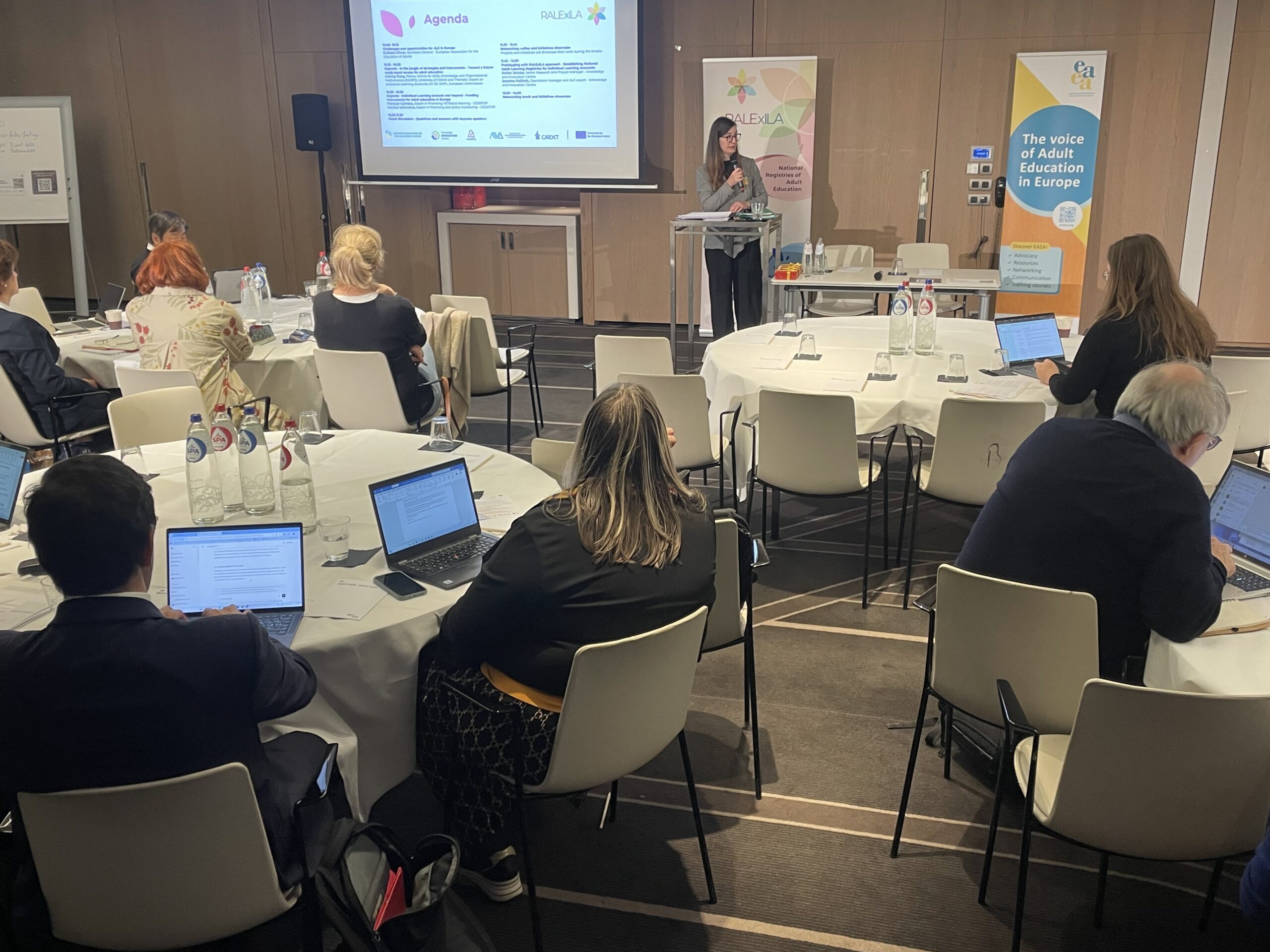
On 3 December 2025, the final conference of the RALExILA project (National Registries of Adult Learning and Education to support the deployment of Individual Learning Accounts) was held in Brussels. As a member of the project’s Advisory Panel, EARLALL participated alongside representatives from national ministries, European institutions, industry, and lifelong learning stakeholders for this closing event.
Challenges and Opportunities for ALE in Europe
The conference, organised by the European Association for the Education of Adults (EAEA), was opened by Raffaela Kihrer, Secretary General at EAEA. Kihrer opened the session by introducing the RALExILA project, outlining its role in strengthening Adult Learning and Education (ALE) systems and supporting the implementation of Individual Learning Accounts (ILAs) across Europe. She highlighted the project’s mission to address fragmented registries, scattered data, uneven quality assurance, and barriers faced by disadvantaged groups, while providing a clear roadmap toward a more integrated lifelong learning ecosystem.
Johnny Sung, Honorable Fellow at the Centre for Skillsm Knowledge and Organisational Performance (SKOPE), Iniversity of Oxford, and Thematic Expert on ILAs for DG EMPLOY, continued Kihrer’s message, emphasizing the role of ILAs in empowering adults to navigate lifelong learning pathways. He noted that fragmented support and overwhelming information often hinder smooth access, particularly for disadvantaged learners. Sung outlined four key principles for effective ILAs and ALE registries:
- Visibility and relevance: creating comprehensive maps of adult learning opportunities
- Trust and quality: providing clear information on accreditation and quality assurance
- Navigation and guidance: enabling learners to filter, compare, and access guidance services
- Recognition and progression: linking courses to qualifications, skills frameworks, and career pathways
Financing and Policy Support for Adult Learning
CEDEFOP experts, Patrycja Lipinska, Expert in Financing VET/adult learning and Mantas Sekmokas, Expert in Financing and Policy Monitoring, presented then the organisation’s long-standing work on financing ILAs and adult education in Europe. They highlighted the role of training funds in ensuring sustainable financing for continuing vocational education and training (CVET). Further explaining that aligning training supply with employer skill needs is a key factor to improve quality and enhance equity for targeted groups.
Prototyping and Interactive Workshops
The event showcased the technical aspects of ALE and ILA systems. Moderated by Stefan Jahnke, Senior Research and Project Manager at the Knowledge and Innovation Centre, he presented RALExILA prototype that integrates ALE and ILA systems through co-design and peer-learning activities with public authorities, ALE organisations, learners, and experts. Technical demonstrations by Domen Bevec illustrated how guidance platforms can provide tailored and accessible information for learners in an easily digestible way.
During the conference breaks, several projects and initiatives were invited to showcase their work. Among them was LCAMP – the Learner-Centric Advanced Manufacturing Platform for Centres of Vocational Excellence (CoVEs), which presented its key achievements and encouraged participants to join the Alliance. EARLALL, on behalf of LCAMP, also invited attendees to take part in the LCAMP Conference and Student Hub, scheduled to take place from 21 to 23 April in the Basque Country.
The afternoon continued with interactive workshops on strategic solutions, followed by focused sessions on:
- Quality assurance across sectors: integrating formal and non-formal learning
- Interoperable information systems: ensuring quality data for policy development
- Governance and policy coherence: promoting multi-stakeholder collaboration
Towards an Integrated ALE System
The final panel, moderated by Zvonka Pangerc-Pahernik, from Andragoški Center Republike Slovenije, discussed the future of ILAs and ALE systems. Ricardo Espinoza, from OECD, stressed that institutions must embrace change to ensure quality across learning contexts. Colin Tuck, from the Knowledge and Innovation Centre, continued this argument, stating that navigation challenges for learners remain a key factor. Eva Farkas, from Szeged University, emphasised the central role of ILAs in lifelong learning, underscoring the central role of innovation. Klara Engels-Perenyi (European Commission, DG EMPL) concluded the panel with a call for determination and long-term commitment to achieving meaningful lifelong learning outcomes.
RALExILA’s final event demonstrated how ALE registries and ILAs can transform access to adult learning, creating inclusive and navigable pathways for all learners. EARLALL’s participation underlines its ongoing commitment to fostering regional collaboration, sharing best practices, and strengthening lifelong learning ecosystems.