

6th International Conference on Gifted Education: Teaching for Excellence
27/04/2026
On 23 April 2026, EARLALL participated online in the 6th International Conference on Gifted Education: “Teaching for Excellence: School-based models and professional capacity for gifted education.” The event was hosted in Varaždin County, an EARLALL member region, highlighting the network’s strong engagement in promoting excellence in education across its regions.
The conference was organised by the European Talent Centre Croatia and held in a hybrid format at Arena Varaždin. It brought together over 1,000 participants from 14 European countries, including more than 450 online attendees, alongside a wide range of international experts, researchers, and practitioners in gifted education.
The conference aimed to strengthen knowledge exchange and support the development of systematic approaches to identifying and nurturing gifted children and students. The discussions closely aligned with the objectives of the LeadEx (Learning about the Educational Approach to Develop Excellence in Social Education and Lifelong Learning) project, particularly in improving education systems, enhancing teacher capacity, promoting inclusion and excellence, and fostering innovation in lifelong learning.
Prof. Dr Colm O’Reilly ( Dublin City University, Ireland) presented key programmes such as talent search assessments, enrichment courses, early university access, and research initiatives. His contribution highlighted a shift from traditional, IQ-based views of giftedness towards more dynamic and holistic approaches that recognise individual development and diverse abilities. He also addressed mental health challenges among adolescents, including gifted learners, and emphasised the importance of supporting twice-exceptional students. His presentation underscored the need for supportive environments that balance achievement with wellbeing.
Prof. Dr Mojca Juriševič (University of Ljubljana, Slovenia) focused on common myths and misconceptions about gifted students, highlighting the critical role of teachers in addressing them. She distinguished between misconceptions, stereotypes, and deeply rooted myths, stressing that while some can be corrected through evidence and awareness, others require broader cultural change. Importantly, she noted that research does not support the assumption that gifted students are more vulnerable than their peers.
Prof. Dr Lianne Hoogeveen (Radboud University, Netherlands) presented giftedness as a dynamic and multifaceted concept shaped by intelligence, environment, and personal development. She emphasised the importance of teacher training and continuous professional development, including programmes such as RITHA, and reiterated that gifted students are not inherently more prone to socio-emotional difficulties.
Mara Sesar (MEd, University of Zagreb Faculty of Humanities and Social Sciences) explored the didactics of gifted education, addressing legal frameworks, identification processes, and teaching approaches. Her presentation highlighted the importance of integrating gifted education within inclusive school systems and presented the Croatian framework, which includes structured identification, individualised curricula, acceleration, and continuous monitoring. Practical approaches such as mentoring, personalised learning, and student-centred methods were also emphasised.
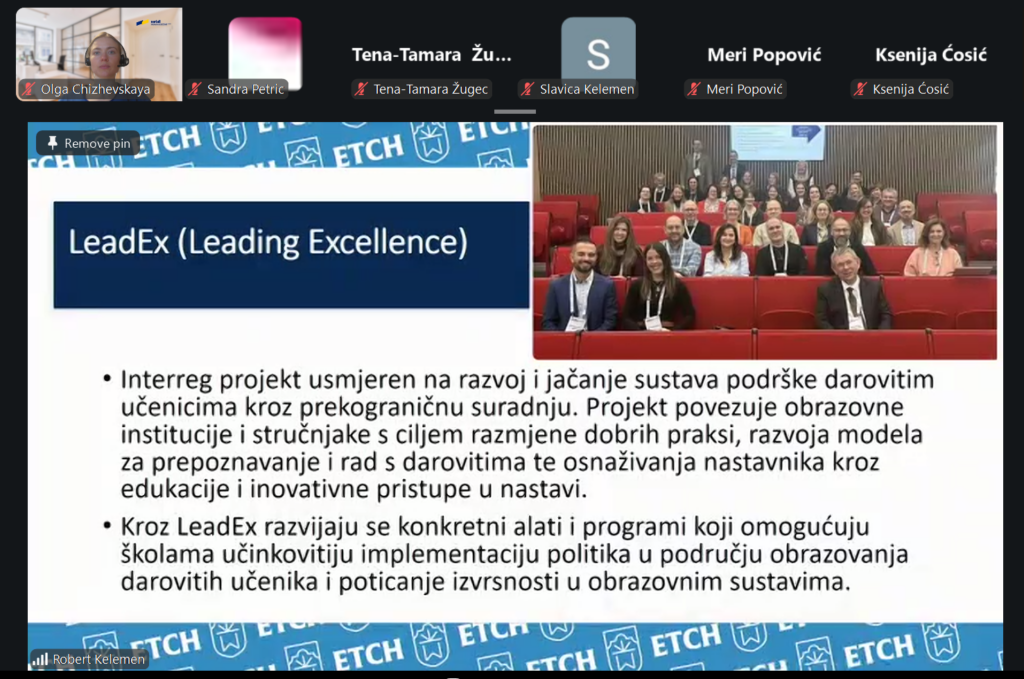
Robert Kelemen (European Talent Center Croatia) introduced a systems approach to the Croatian education model, linking inputs, educational processes, and outcomes. He highlighted the role of the European Talent Centre Croatia in supporting gifted education through training, Centres of Excellence, and professional development. He also presented the LeadEx project, which promotes interregional cooperation, exchange of good practices, and innovative policy approaches.
Irena Kos Kukec (European Talent Center Croatia) outlined a structured professional development programme for educators, designed to strengthen their capacity to support gifted learners. The programme covers identification, curriculum design, socio-emotional support, and monitoring of student progress.
The conference concluded with an online presentation by Prof. Dr Albert Ziegler (Friedrich-Alexander University Erlangen-Nuremberg, Germany), who introduced the concepts of “megatopes” and the “X factor” in talent development. He emphasised that high-performing individuals are key drivers of innovation and economic growth, and that talent flourishes in systems with strong institutional support. According to his model, well-developed systems create “talent powerhouses,” while insufficient support leads to “talent deserts.” He concluded that talent is not fixed, but emerges where resources and opportunities are effectively aligned.
Overall, the conference highlighted the importance of systemic, inclusive, and forward-looking approaches to gifted education – principles that are central to the LeadEx project and EARLALL’s mission to support policy learning and innovation in education across European regions.