

LeadEx Study Visit in Estonia
16/03/2026
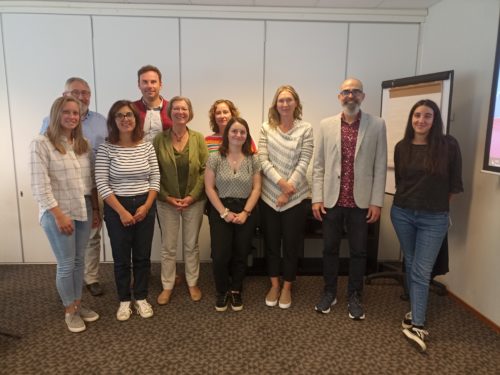
Between 9–11 March, EARLALL was invited to the LeadEx project study visit in Tallinn,
Estonia. Gathering stakeholders, regional representatives, project partners and experts, these
days focused on the Estonian education system and discussed the findings from EARLALL’s
Joint Regional Report.
Heli Mattisen, the Director of HAKA, opened the event by reiterating the strong role of
education in today’s society, highlighting education as one of the key solutions for mitigating
societal prejudices and social exclusion.
Helen Arus, Head of General Education in HAKA, continued Mattisen’s message by
presenting insights on the Estonian education system. Emphasizing their opportunity to
rebuild its system after the Soviet Union by adopting an innovative and digital system. Arus
concluded her presentation with the importance of trust and autonomy and collaborating
closely with the labour market.
EARLALL plays a central role in the LeadEx project as communication manager and
advisory partner. Based on data provided through a dedicated survey among the project
regions, EARLALL presented the Joint Regional Educational Diagnosis Report. This report
aims to provide a comparative analysis of education systems across partner regions that will
be an important base for structuring the policy instruments. The report analyzed policy needs,
key challenges and strengths in relation to four sub-themes that define the LeadEx project:
- Inclusion, diversity and excellence, such as meeting the needs of all students,
regardless of their abilities, cultural background or personal circumstances; - Educational innovation, for instance adopting new technologies and pedagogical
methods; - Integral development, exemplifying that excellence is not only referring to academic
skills, but personal growth, fostering soft skills, emotional and ethical skills; - Continuous Professional Development for teachers (CPD), ongoing teacher
training is essential to keep up to date with best pedagogical practices.
Teachers’ Professional Development (CPD) was the main focus for this study visit. Therefore,
EARLALL constructed an interactive workshop following the results of a report from the
Central Denmark Delegation. The workshop later provided participants the opportunity to
explore and discuss their best practices in groups.
The second day in Estonia, Taavi Kreitsmann from the Ministry of Education and Research
gave an overview of the current teacher professional development. He further discussed the
nationwide framework as an example of the contemporary approach to teaching and learning,
emphasizing initial planning as key to make pathways more effective and flexible.
Thereafter, Sigrid Aruväli, Head of Centre for Innovation in Education in Tallinn University,
explained the collaboration between Estonian universities, schools and teachers. Aruväli
explained that 1 in 4 novice teachers leave in the first years; to combat this problematic they
aimed to improve the cooperation between higher education institutions and schools, giving
novice teachers the opportunity to work with mentor teachers.
After Kreitsmann’s and Aruväli’s interventions, representatives from Central Denmark
region, Murcia (Spain), Podkarpackie (Poland), and the Ministry of Education in Slovenia
presented best practices from their respective regions. Varazdin County and Montenegro
conducted hands-on workshops for the project partners and stakeholders, focusing on
emphatic learning and creativity.
The last day concluded with an in-depth explanation about the results behind Estonia’s PISA
outcomes, comparing the education system before and after the Soviet period. Giving the
opportunity to visit one of Estonias VET schools. The study visit offered participants an
understanding of the structure of the system and how it closely intertwines with everyday life,
effectively strengthening lifelong learning. As the communication and advisory partner,
EARLALL remains committed to continuing exploring regional education and how to
leverage excellence, inclusion and digital innovation through effective interregional
cooperation and exchange of best practices. The next study visit will take place in
Montenegro, where partners will continue exploring strategies for inclusion, diversity, and
excellence, further strengthening interregional cooperation and the exchange of best practices.
After Kreitsmann’s and Aruväli’s interventions, representatives from Central Denmark
region, Murcia (Spain), Podkarpackie (Poland), and the Ministry of Education in Slovenia
presented best practices from their respective regions. Varazdin County and Montenegro
conducted hands-on workshops for the project partners and stakeholders, focusing on
emphatic learning and creativity.
The last day concluded with an in-depth explanation about the results behind Estonia’s PISA
outcomes, comparing the education system before and after the Soviet period. Giving the
opportunity to visit one of Estonias VET schools. The study visit offered participants an
understanding of the structure of the system and how it closely intertwines with everyday life,
effectively strengthening lifelong learning. As the communication and advisory partner,
EARLALL remains committed to continuing exploring regional education and how to
leverage excellence, inclusion and digital innovation through effective interregional
cooperation and exchange of best practices. The next study visit will take place in
Montenegro, where partners will continue exploring strategies for inclusion, diversity, and
excellence, further strengthening interregional cooperation and the exchange of best practices.
11/02/2026
TBM Working Group Experts Share Insights: Boosting Talent Through Innovation, Skills and Quality of Life
Register here.
Public Workshop within the 2025 EARLALL Annual Meeting
05/11/2025
On 5 November 2025, the EARLALL Public Workshop titled Empowering Futures: Boosting VET and ALE Attractiveness Across Regions took place in Mechelen, Belgium, organised by EARLALL in cooperation with Crescendo CVO. The event, held in the context of the three-day EARLALL Annual Meeting, brought together representatives from EARLALL member regions, the European Commission, research institutions, and practitioners in Vocational Education and Training (VET) and Adult Learning and Education (ALE).
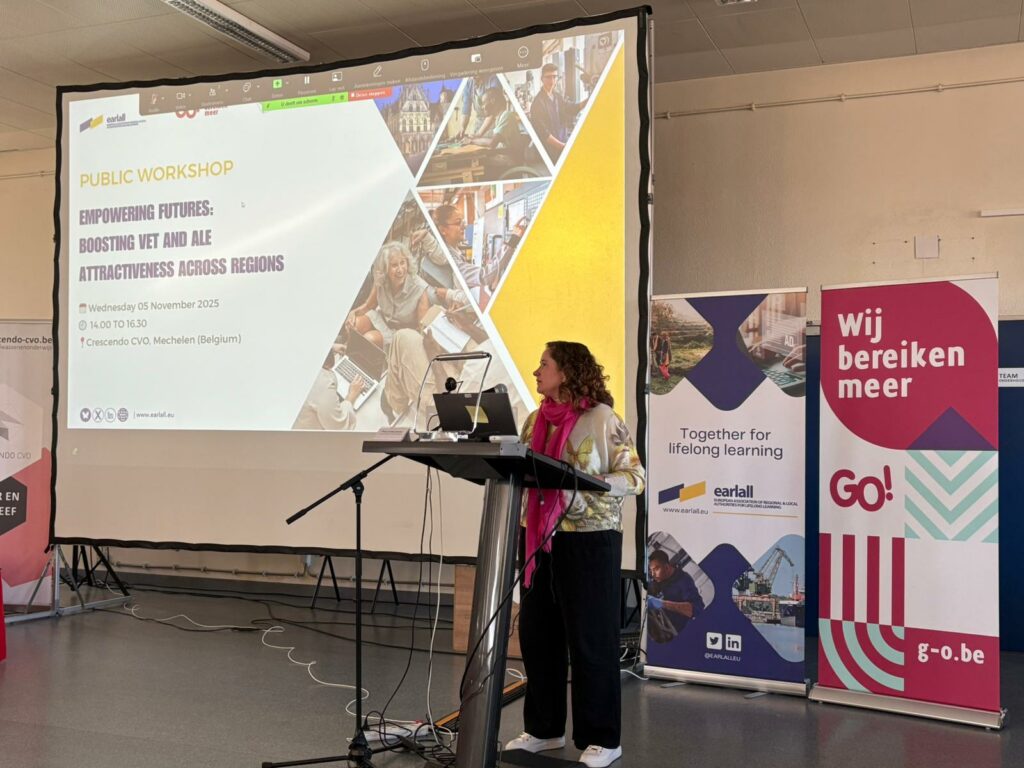
The workshop, moderated by Míriam Castillo González, Head of Unit for Programmes and Projects at the Directorate-General for Vocational Education and Training, Ministry of Education and VET of Catalonia, provided a platform for exchanging experiences and discussing how to enhance the appeal and value of VET and ALE across European regions.
Opening and Regional Context
The event was opened by Sabe de Graef, Councillor of the City of Mechelen, who underlined the key role of local authorities in building inclusive and engaging learning environments. She noted that Mechelen continues to address high school dropout rates (around 18%, higher in VET) by promoting a positive school climate, youth engagement, and strong partnerships with the health and employment sectors.
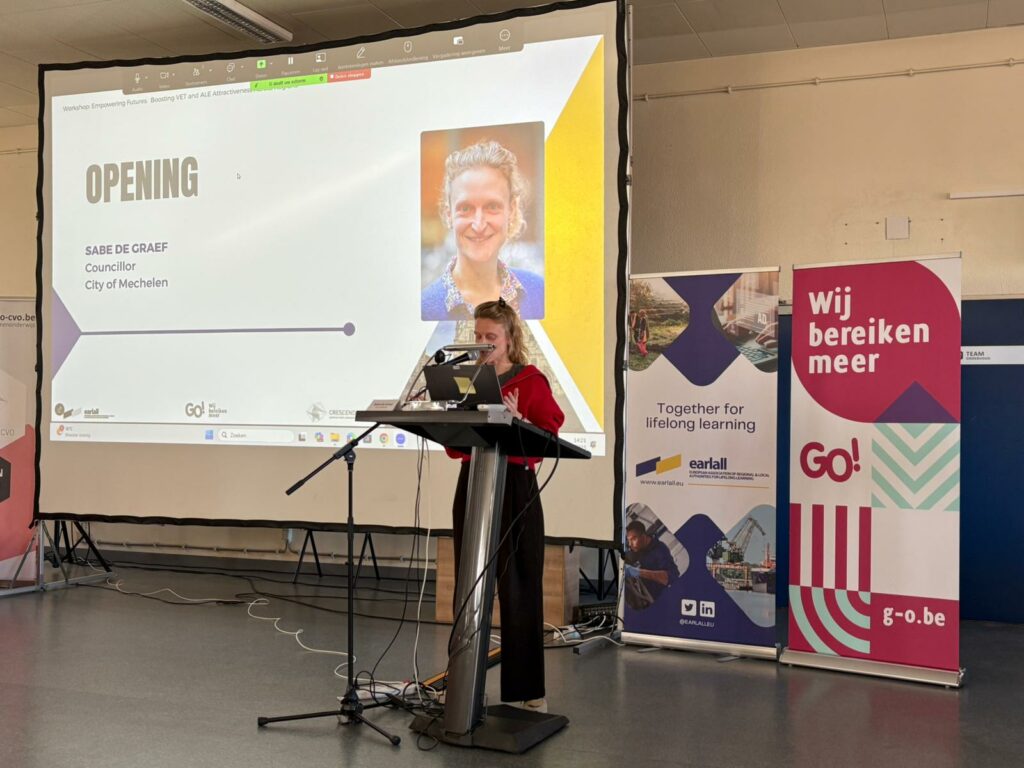
Sabe also presented the local initiative, a network of over 160 partners that has supported from 150 to 1,300 individuals over four years, helping early school leavers return to education and achieve a secondary qualification.
This was followed by a presentation from Jens Vermeersch (Internationalisation Policy Coordinator at GO! Onderwijs van de Vlaamse Gemeenschap) and Marleen Mast (Director of Crescendo CVO), who introduced the “Attractiveness in Flanders” initiative. Their intervention showcased how Flanders is building a positive image of VET by focusing on high-quality teaching, collaboration with enterprises, and flexible learning pathways for both young people and adult learners.
European Union view on the Future of VET
A keynote speech by Hjordis Virgarsdottir Dalsgaard from the European Commission’s Directorate-General for Employment, Social Affairs and Inclusion provided a broader European perspective.
Her presentation outlined how recent EU policy developments – from the 2024–2029 European Commission Political Guidelines and the 2024 Draghi Report to the upcoming European VET Policy 2026–2030 – reinforce a strong focus on skills, innovation, and inclusion.
Dalsgaard emphasised that the Herning Declaration (2025) renews Europe’s joint commitment to VET for the period 2026–2030, reaffirming the 2020 VET Recommendation and the Osnabrück Declaration, while introducing the concept of a “Union of Skills”.
She also presented recent EU figures showing that over half of young Europeans (52.4%) are enrolled in VET programmes, with two-thirds engaged in work-based learning. The graduate employment rate stands at 80%, close to the European target of 82%. However, she noted that VET learner mobility remains low, with only 5.3% of students participating in cross-border experiences in 2023 – still below the 2030 target of 12%.
Research and Policy Implications
Dr Paul Redmond, Associate Research Professor at the Economic and Social Research Institute (Ireland), presented the latest findings from the TRAILS research project on participation in VET and ALE, and discussed their implications for regional policymaking. He underlined that the attractiveness of vocational and adult education depends not only on the quality of programmes, but also on social perception, including the status of vocational professions and the involvement of employers in the training process.
Panel Discussion: Regional Approaches
A lively panel discussion, moderated by Professor Paolo Federighi from the University of Florence, allowed EARLALL regions to share their strategies for strengthening VET and ALE attractiveness.
The panel unfolded in two thematic rounds:
- Round 1: Aligning VET with labour market needs through partnerships and the use of skills intelligence data;
- Round 2: Attracting new learners and engaging adults, particularly those with low skills, in upskilling and reskilling initiatives.
Knut Becker from Baden-Württemberg’s Competence Centre for Adult Basic Education presented Alliance for Lifelong Learning and examples for Workplace Oriented VET.
Inge Gorostiaga Luzárraga from the Basque Country described a collaborative VET network involving schools, enterprises, and innovation centres, enabling flexible, lifelong learning pathways tailored to individual needs.
From Toscany region, Miriana Bucalossi outlined how regional skills governance translates the Herning Declaration’s objectives into action through social dialogue, tripartite cooperation, and tools such as the Quality Charter for Apprenticeships.
Maria Nordh, Policy Advisor from Region Västra Götaland (Sweden), presented the region’s coordinated approach to strategic skills supply and labour market matching. She explained how Västra Götaland aligns regional development, skills provision, and lifelong learning through systematic dialogues with industry and forums bringing together education providers, employers, and public agencies.
Finally, Julia Burkhard from Movetia (Switzerland) presented the Swiss model, showing how regional coordination and cross-border cooperation enhance the quality, mobility, and international visibility of VET.
Closing and Study Visit
The session concluded with closing remarks and an invitation to join the study visit to Crescendo CVO (16:45–18:15), where participants could observe innovative local practices supporting the development of VET and ALE in the Mechelen area.
EARLALL and its member regions remain committed to promoting VET and ALE as cornerstones of Europe’s social and economic resilience.
x
03/04/2025
x
12/09/2022
|
|
 Dr. Emma Francis |
 Neus Caufapé |
VET’s CLIL recommendation for education providers and policy makers now available!
24/08/2021
In the framework of the VET’s CLIL project, co-funded by the Erasmus+ programme of the European Union (KA2), EARLALL has produced a set of recommendations for education providers and policy makers within the pathway towards integrating Content Language Integrated Learning (CLIL) in Vocational Education and Training (VET). The VET’s CLIL project is aimed at widening the opportunities of VET students in a globalised world by implementing the CLIL methodology in the curricula, and this report comes to complement the practice-oriented efforts of the project.
The report contains an introduction which sets its objectives and explains its methodology. Then, it presents an overview of the state-of-art of CLIL research in Europe in the past, present and future. The policy context of the development of CLIL is also depicted and includes information about key actors, the European policy context, EU support to foreign languages and references to the CLIL methodology in EU documents. This part also focuses on the national and regional context for the implementation of CLIL.
Building on these data, policy recommendations at EU, national, regional and local levels are provided. Policy reviews show that while theoretical support is provided, especially in EU documents, further efforts are needed in a coherent approach to the implementation of CLIL, particularly at national and regional level. As solution is proposed to build skills ecosystems that foster language learning at local and regional level, and a multi-level approach is called for. In addition, the recommendations highlight areas of further research in evidence-based policy making and exploitation opportunities in other sectors.
The VET’s CLIL project is finishing in August 2021 after 36 months of common work.